
Winter has a way of making even the most reliable skincare routine feel completely useless. One day your skin looks perfectly fine, and the next it’s tight, flaky, irritated, or suddenly refusing to cooperate with your favorite moisturizer. The good news? Your skin probably doesn’t need an entirely new routine. It just needs a little help adjusting to the season.
Cold weather changes more than our wardrobes. It also changes the environment our skin has to deal with every day. Between freezing temperatures, indoor heating, long hot showers, and dry air, winter can be surprisingly demanding on the skin.
And while social media might suggest that the answer is another serum or a complicated ten-step routine, healthy winter skin usually comes down to understanding a few simple things.
This winter skincare guide explains what actually happens to your skin during the colder months, which ingredients are worth knowing about, and how to keep your skin comfortable without overcomplicating your bathroom shelf.
Why Does Your Skin Get So Dry in Winter?
If your skin suddenly feels drier when the temperature drops, there’s a scientific reason behind it.
Cold air generally holds less water vapor than warm air, and winter often brings lower humidity levels. Once we turn on the heating indoors, the relative humidity can drop even further.
This creates an environment where water evaporates from the skin more easily.
Our skin naturally loses a certain amount of water throughout the day. This process is called transepidermal water loss, or TEWL.
It’s completely normal, but when the skin’s protective barrier isn’t functioning as effectively as it should, more moisture can escape.
That’s when you might start noticing:
- Tightness, especially after washing your face
- Rough or flaky patches
- Increased sensitivity
- Itching or discomfort
- Makeup clinging to dry areas
- Cracked lips and dry hands
- Skin that looks duller than usual
Even people with oily or combination skin can experience these problems.
In fact, your skin can feel greasy in certain areas while still struggling with dryness or dehydration elsewhere.
The important thing to understand is that winter dryness isn’t necessarily a sign that you’re using the wrong products. Sometimes, the environment has simply changed faster than your routine.
What Is the Skin Barrier, and Why Is Everyone Talking About It?
You’ve probably seen the term skin barrier everywhere lately.
It’s become one of the biggest talking points in skincare, and unlike some beauty buzzwords, this one deserves the attention.
Your skin barrier is primarily associated with the outermost layer of your skin, called the stratum corneum.
Imagine a brick wall.
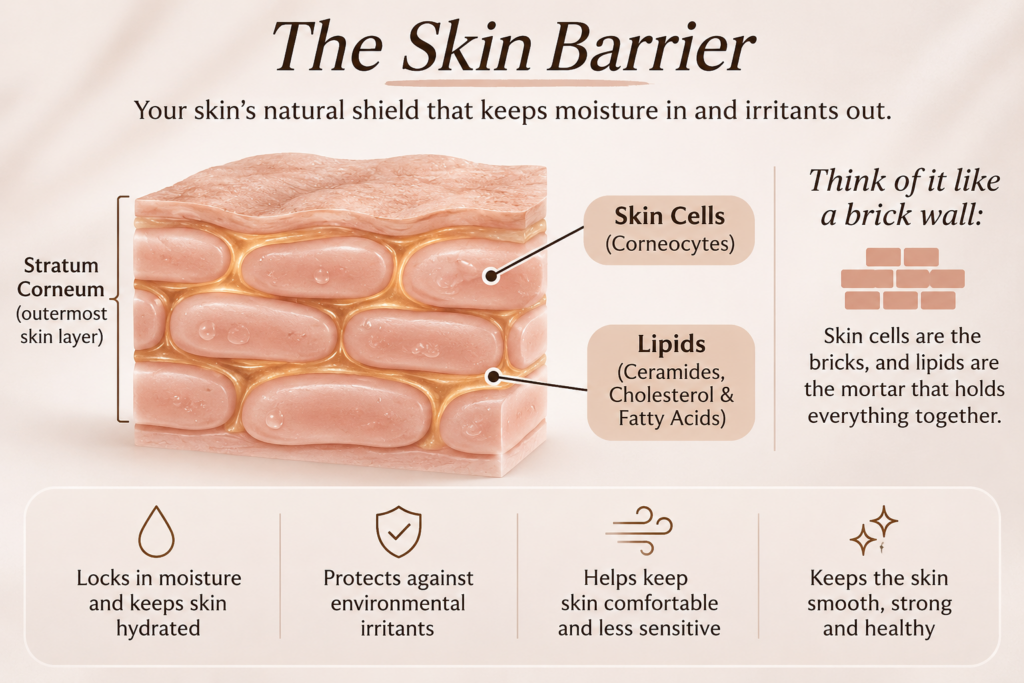
The skin cells are the bricks, while the natural lipids surrounding them act like the mortar holding everything together.
These lipids include ceramides, cholesterol, and fatty acids.
Together, they help prevent excessive water loss while protecting the skin from environmental irritants.
When this protective system is working properly, your skin is generally better able to retain moisture and tolerate everyday conditions.
But when it’s disrupted, things can become uncomfortable.
Signs Your Skin Barrier May Be Struggling
A weakened or irritated skin barrier can be associated with several symptoms:
- Persistent dryness despite moisturizing
- Burning or stinging when applying products
- Unusual sensitivity to familiar skincare
- Redness or irritation
- Flaking and rough texture
- Increased discomfort after cleansing
These symptoms aren’t enough to diagnose a damaged barrier on their own. Conditions such as eczema, contact dermatitis, and rosacea can cause similar reactions.
Still, they are useful signs that your skin may need a gentler approach.
The takeaway: Supporting your skin barrier isn’t about chasing a perfect complexion. It’s about helping your skin perform its normal protective functions.
And sometimes, that means doing less.
Dry Skin vs. Dehydrated Skin: What’s the Difference?
These two terms are often used interchangeably, but they describe different things.
Dry Skin
Dry skin is generally considered a skin type characterized by lower levels of natural oils or lipids.
People with naturally dry skin may experience roughness, tightness, and flaking throughout the year, although winter can make these symptoms worse.
Dry skin often benefits from richer moisturizers containing ingredients that soften the skin and reduce moisture loss.
Dehydrated Skin
Dehydration refers to a lack of water in the skin rather than a lack of oil.
It’s a description of the skin’s condition, not a separate medical skin type.
Even oily skin can become dehydrated.
Common complaints include tightness, a less supple appearance, and discomfort after cleansing.
However, appearance alone can’t reliably tell you whether your skin is dehydrated, dry, irritated, or affected by another condition.
Can You Have Both?
Absolutely.
Someone with naturally dry skin can also experience increased water loss during winter.
That’s why effective skincare often combines ingredients that attract water with ingredients that help prevent it from escaping.
Understanding this distinction is useful, but you don’t need to label every skin concern perfectly before making sensible changes.
Start with how your skin feels and responds.
The Winter Skincare Ingredients Worth Understanding
Beauty packaging is full of impressive-sounding ingredients, but you don’t need to memorize an entire chemistry textbook.
A few ingredient categories explain most of what a good winter moisturizer is trying to accomplish.
1. Ceramides: Supporting the Skin Barrier
Ceramides are lipids naturally found in the outer layer of the skin.
They play an important role in maintaining the protective barrier and reducing excessive water loss.
Moisturizers containing ceramides can help support dry or barrier-compromised skin.
They’re particularly useful to look for if your skin becomes rough, uncomfortable, or easily irritated during winter.
Ceramides aren’t a miracle ingredient, though. The overall formulation matters just as much as the presence of a particular ingredient on the label.
2. Hyaluronic Acid: Helping Skin Hold Water
Hyaluronic acid is a humectant, meaning it attracts and binds water.
It’s naturally present in the body and is widely used in skincare because of its water-binding properties.
In a moisturizer, it can help improve the skin’s hydration.
But here’s something worth knowing: a hyaluronic acid serum isn’t automatically enough to manage very dry skin.
A formula containing humectants alongside emollients and occlusive ingredients may be more useful when moisture loss is a problem.
3. Glycerin: The Underrated Hydration Ingredient
Glycerin doesn’t always get the same attention as trendier ingredients, but it’s a well-established humectant.
It helps attract water and improve skin hydration.
You’ll find it in everything from affordable moisturizers to more expensive skincare formulas.
And that’s an important reminder: an effective ingredient doesn’t have to come with a luxury price tag.
4. Petrolatum: Preventing Moisture Loss
Petrolatum, commonly known as petroleum jelly, is an occlusive ingredient.
Rather than adding water directly to the skin, it forms a protective layer that reduces water loss.
It can be especially helpful for very dry lips, hands, and small areas of rough skin.
However, applying a heavy occlusive layer over irritating products won’t necessarily solve the underlying problem.
If your skin is inflamed, sensitive, or reacting to a treatment, the cause of that irritation still matters.
5. Squalane and Other Emollients: Softening Rough Skin
Emollients help smooth and soften the skin.
Ingredients such as squalane, shea butter, and certain plant-derived oils can improve how dry skin feels by helping fill gaps between surface skin cells.
Some people prefer lightweight emollients, while others benefit from richer formulas.
Neither approach is automatically better.
The right texture depends on your skin type, the weather, and how your skin responds.
So, Which Ingredients Should You Choose?
Instead of searching for one perfect ingredient, think about what your skin needs.
If it feels tight and dehydrated, a moisturizer with humectants may help.
If it’s rough and flaky, emollients can improve comfort.
If moisture seems to disappear quickly, a richer cream with occlusive ingredients may be useful.
Many well-formulated moisturizers combine all three functions.
And for most people, that’s much simpler than layering several separate serums.
Understanding skincare ingredients can also make it easier to recognize which products are worth considering, regardless of their price. If you’re curious about affordable beauty options, explore our 15 Beauty Finds Under $25 for more inspiration.
Winter Skincare Guide: Building a Simple Morning and Evening Routine
A winter routine doesn’t need ten steps, expensive treatments, or a completely new collection of products.
In fact, if your skin is feeling sensitive, simplicity is often the smartest place to start.

Your Morning Winter Skincare Routine
Step 1: Cleanse gently
If your skin is particularly dry, you may not need a full cleanser every morning.
Some people do well with a gentle rinse using lukewarm water, while others prefer a mild, fragrance-free cleanser.
The goal is to remove what needs removing without leaving your face feeling stripped or uncomfortable.
Step 2: Apply moisturizer
Choose a moisturizer that suits your skin type and the level of dryness you’re experiencing.
A lightweight cream might be enough for combination skin, while naturally dry skin may benefit from a richer formula.
Applying moisturizer while your skin is still slightly damp can help retain moisture.
Step 3: Don’t forget sunscreen
Yes, even in winter.
UV radiation doesn’t disappear when temperatures drop, and snow can reflect sunlight.
The American Academy of Dermatology recommends broad-spectrum, water-resistant sunscreen with SPF 30 or higher, alongside other sun-protective measures.
This is one skincare step that shouldn’t be treated as seasonal.
Your Evening Winter Skincare Routine
Step 1: Remove makeup and sunscreen gently
Use a cleanser appropriate for your skin and the products you’ve worn that day.
Avoid aggressive scrubbing or repeatedly washing your face until it feels squeaky clean.
That tight, overly clean sensation isn’t a sign that your cleanser is working better.
Step 2: Reconsider strong active ingredients
If you’re using retinoids, exfoliating acids, or other potentially irritating treatments, pay attention to how your skin responds during colder weather.
Some people tolerate their usual routine perfectly well all year.
Others notice more dryness or irritation and may need to adjust how frequently they use certain products.
If you’re using a prescription treatment, discuss significant changes with your prescribing clinician.
Step 3: Moisturize
Evening is a convenient time to use a richer moisturizer if your skin needs one.
You can also apply a small amount of plain petroleum jelly to particularly dry lips or other suitable areas.
The point isn’t to create the thickest possible layer.
It’s to help your skin stay comfortable overnight.
Seven Winter Skincare Mistakes That Can Make Dryness Worse
Sometimes, improving your skin isn’t about adding something new.
It’s about changing a few habits that quietly make dryness worse.
1. Taking Long, Hot Showers
A hot shower after a freezing day feels amazing.
Unfortunately, very hot water and prolonged bathing can worsen dry skin.
Try warm water instead, keep showers relatively short, and moisturize soon afterward.
The American Academy of Dermatology suggests limiting baths and showers to around five to ten minutes when managing dry skin.
2. Exfoliating Every Flaky Patch
When skin starts peeling, it’s tempting to reach for a scrub or exfoliating acid.
But visible flakes don’t automatically mean your skin needs exfoliation.
They may be a sign of dryness or irritation.
Aggressive exfoliation can make the situation worse, especially when the skin barrier is already struggling.
Focus on gentle cleansing and moisturizing first.
3. Using Too Many Active Ingredients at Once
Retinol, vitamin C, exfoliating acids, and other active ingredients can all have a place in skincare.
That doesn’t mean everyone needs to use them together.
Layering several potentially irritating products, particularly while introducing them for the first time, increases the chance of discomfort.
A complicated routine isn’t necessarily a better routine.
4. Assuming Oily Skin Doesn’t Need Moisturizer
Oil production and skin hydration aren’t the same thing.
People with oily skin can still experience dryness, tightness, and irritation.
The solution isn’t necessarily a heavy cream.
A lightweight, non-comedogenic moisturizer may be more comfortable.
5. Ignoring Fragrance Sensitivity
Fragrance can make skincare feel luxurious, but it can also irritate sensitive skin.
If you’re experiencing persistent dryness or stinging, fragrance-free products are often a sensible choice.
And remember: unscented doesn’t always mean fragrance-free.
Some unscented products contain ingredients designed to mask an existing scent.
6. Forgetting About Indoor Air
We spend a lot of winter indoors, often surrounded by central heating.
Dry indoor air can contribute to skin discomfort.
A properly maintained humidifier may help in particularly dry environments, although it isn’t essential for everyone.
Keep humidity at a reasonable level and clean the device according to its instructions to avoid mold and microbial growth.
7. Changing Your Entire Routine Overnight
When skin becomes irritated, it’s easy to assume every product needs replacing.
But introducing several new formulas at once makes it difficult to identify what’s helping or causing problems.
Try making targeted changes instead.
Your skin may simply need a gentler cleanser or a more protective moisturizer.
What About Slugging, Skin Cycling, and Other Skincare Trends?
Skincare trends can be useful sources of ideas, but they’re not universal instructions.
Here’s how to think about a few popular approaches during winter.
Slugging
Slugging involves applying an occlusive product, commonly petroleum jelly, as a final step to reduce moisture loss.
It may be helpful for some people with dry skin.
However, full-face slugging isn’t necessary for everyone, particularly those who are acne-prone or find heavy products uncomfortable.
It can also be a poor choice over irritating active treatments.
A small amount applied to specific dry areas may be more practical than covering your entire face.
Skin Cycling
Skin cycling generally refers to rotating active treatments and recovery nights rather than using strong products every evening.
The underlying idea of allowing skin time to recover can be useful.
But there isn’t one scientifically established skin-cycling schedule that everyone needs to follow.
Your tolerance, skin concerns, and any prescribed treatments should guide your routine.
The Skin Barrier Trend
Barrier-focused skincare is one of the more useful ideas to emerge from beauty conversations.
But the marketing can become excessive.
You don’t necessarily need a separate barrier serum, barrier cream, barrier mask, and barrier mist.
A gentle cleanser and a well-formulated moisturizer may already provide the support your skin needs.
The lesson? Use skincare trends as information, not as a shopping checklist.
Don’t Forget Your Lips, Hands, and Body
Winter skincare conversations tend to focus almost entirely on the face.
Meanwhile, our hands and lips are often dealing with just as much dryness.
How to Prevent Chapped Lips
Lips have a relatively delicate protective surface and are especially vulnerable to drying out.
Cold air, wind, and frequent lip licking can make things worse.
A simple, non-irritating lip balm or plain petroleum jelly can help protect them.
If a lip product causes burning, stinging, or tingling, that isn’t necessarily a sign that it’s working.
It may be irritating your lips.
Why Your Hands Need Extra Attention
Frequent handwashing, cleaning products, and exposure to cold weather can leave hands dry and cracked.
Apply hand cream after washing, wear gloves outdoors, and use protective gloves when handling household cleaning products.
If the skin becomes painful, deeply cracked, or persistently inflamed, professional advice may be necessary.
Your Body Needs Moisture, Too
Dry legs, itchy arms, and rough elbows are common winter complaints.
Applying a cream or ointment after bathing can help reduce moisture loss.
If wool or rough fabrics irritate your skin, try wearing a softer layer underneath.
Small changes in your daily routine can make a noticeable difference.
When Is Dry Skin More Than Just Winter Dryness?
Not every dry patch is caused by cold weather.
Persistent itching, inflammation, painful cracks, or recurring rashes can sometimes indicate a condition such as eczema, contact dermatitis, or psoriasis.
It’s worth speaking to a dermatologist if:
- Dryness doesn’t improve with consistent gentle care
- Your skin becomes painful, cracked, or bleeds
- Products repeatedly cause burning or stinging
- You develop persistent redness, itching, or a rash
- Symptoms interfere with sleep or everyday activities
Seek prompt medical care for signs of infection, such as spreading redness, warmth, swelling, pus, or fever.
Skincare advice on the internet can help with everyday habits, but it can’t replace an individual medical assessment.
Winter Skincare FAQ
Should I use a thicker moisturizer in winter?
Not necessarily, but many people benefit from switching to a richer cream when temperatures drop and indoor air becomes drier.
If your current moisturizer keeps your skin comfortable, there’s no reason to replace it simply because the season has changed.
Is hyaluronic acid good for winter?
Yes. Hyaluronic acid is a useful humectant that helps bind water.
For very dry skin, it may work best as part of a moisturizer that also contains emollient and occlusive ingredients.
Can I still use retinol during winter?
Many people can.
However, retinoids may cause dryness and irritation, particularly when first introduced.
If your skin becomes uncomfortable, consult your dermatologist or prescribing clinician about adjusting your routine.
Should I exfoliate dry skin?
Not automatically.
If your skin is flaky because it’s dry or irritated, exfoliating may make matters worse.
Start with gentle cleansing and regular moisturizing.
Do I really need sunscreen when it’s cloudy or snowing?
Yes. UV exposure can occur on cloudy days, and snow reflects UV radiation.
Broad-spectrum SPF 30 or higher is recommended for exposed skin when sun protection is needed.
How long does it take for winter dry skin to improve?
Mild seasonal dryness may improve within days to a couple of weeks with consistent care.
More severe irritation or an underlying skin condition can take longer and may require treatment.
If symptoms persist or worsen, seek professional advice.
The Bottom Line: Healthy Winter Skin Doesn’t Have to Be Complicated
The most important lesson from this winter skincare guide is that healthy skin doesn’t require an endless collection of products or a complicated ten-step routine.
It’s about recognizing that your skin’s needs can change with the environment.
A gentle cleanser, a suitable moisturizer, daily sun protection, and a few adjustments to everyday habits can make a meaningful difference.
Pay attention to how your skin feels. Be cautious with ingredients that cause irritation. And remember that a higher price tag or longer ingredient list doesn’t automatically mean better results.
Sometimes the most effective skincare routine is simply the one that gives your skin what it needs, without asking it to tolerate anything unnecessary.
Because healthy skin isn’t about looking flawless in winter.
It’s about feeling comfortable in it.
Sources & Further Reading
For readers who want to explore the science and dermatology guidance behind these recommendations:
- American Academy of Dermatology — Dermatologists’ Top Tips for Relieving Dry Skin
- American Academy of Dermatology — How to Pick the Right Moisturizer for Your Skin
- American Academy of Dermatology — Cold Weather and Your Skin
- National Eczema Association — 6 Tips to Calm Eczema in the Winter
- Cleveland Clinic — How to Prevent Dry Skin This Winter
This article is intended for general educational purposes and is not a substitute for professional medical advice.
Leave a Reply