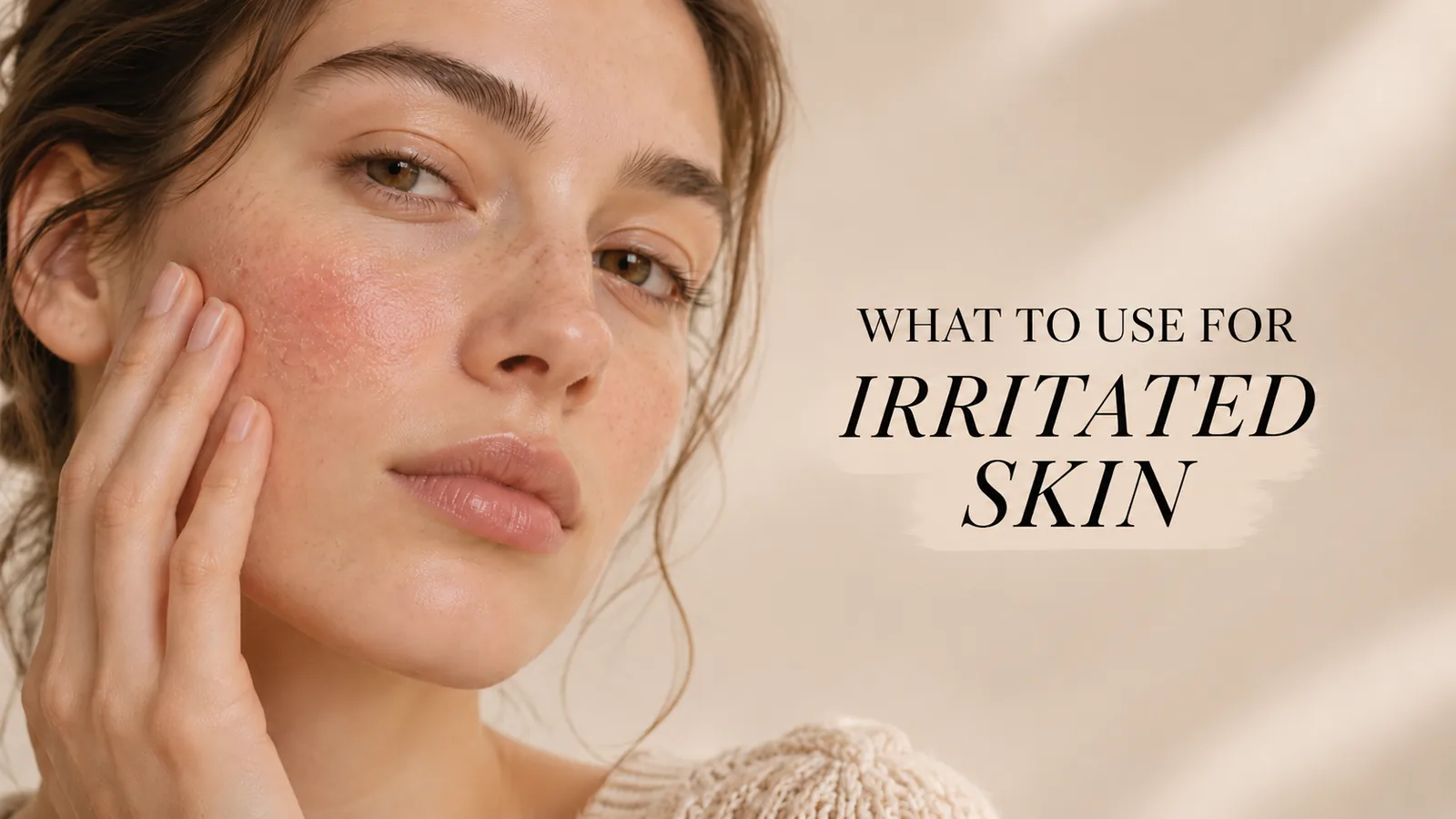
You know that feeling when your usual moisturizer suddenly stings, your cheeks look unusually red, and even washing your face feels uncomfortable? Your skin might be telling you it needs a break. Irritated skin doesn’t necessarily need an expensive new routine. Sometimes, the best thing you can do is simplify everything.
A simple calming skincare routine can make a real difference when your skin feels overwhelmed, especially when you focus on gentle cleansing, hydration, and barrier support.
Amazon Associates Disclosure
As an Amazon Associate I earn from qualifying purchases.
If you’re looking for gentle formulas to help bring some comfort back to your skin, I’ve put together a curated collection of calming skincare essentials on Amazon, featuring moisturizers, hydrating products, and barrier-focused skincare worth exploring.
Why Does Your Skin Suddenly Feel So Sensitive?
Skin irritation can seem to appear out of nowhere. One week, your skincare routine works perfectly. The next, your face feels tight, looks blotchy, or reacts to products you’ve used for months.
There are several possible explanations.
Overusing exfoliating acids, introducing too many active ingredients, harsh cleansing, cold weather, and even frequent washing can affect the skin’s protective barrier.
But irritation isn’t always caused by skincare. Conditions such as eczema, rosacea, or contact dermatitis can produce similar symptoms.
The important distinction? Sensitive skin is not necessarily the same as a damaged skin barrier.
Some people naturally have more reactive skin, while others experience temporary sensitivity after overexfoliating or using irritating products.
Understanding what’s happening beneath the surface makes choosing the right products much easier.
The goal of calming skincare isn’t to eliminate every possible skin reaction overnight. It’s to identify potential triggers, reduce unnecessary irritation, and create a routine your skin can comfortably tolerate.
What Is Your Skin Barrier, and Why Does It Matter?
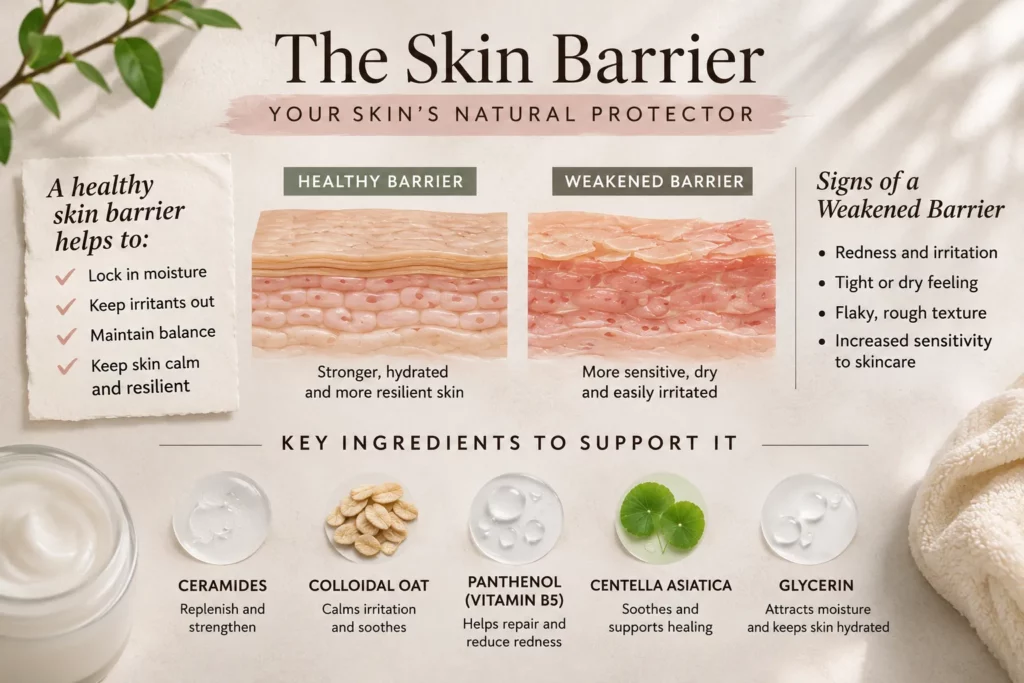
Your skin barrier is essentially your body’s built-in protective shield.
More specifically, the outermost layer of your epidermis, called the stratum corneum, plays an essential role in keeping moisture inside your skin while limiting the entry of external irritants.
Think of it like a brick wall.
The skin cells are the bricks, while a mixture of lipids, including ceramides, cholesterol, and fatty acids, acts like the mortar holding everything together.
When this structure works properly, skin retains moisture more effectively and is better protected against everyday environmental stressors.
When it becomes disrupted, the skin may lose water more easily and become increasingly reactive.
Dermatologists refer to this process as transepidermal water loss (TEWL), which describes water evaporating through the skin.
For a deeper look at the science, DermNet’s explanation of skin barrier function breaks down how the stratum corneum protects the skin and regulates water loss. It’s a useful reminder that barrier health is about much more than simply applying a hydrating cream.
A healthy barrier helps regulate that water loss. A weakened barrier may allow more moisture to escape, contributing to dryness, tightness, and irritation.
Signs Your Skin Barrier Might Need Extra Attention
Common warning signs include:
- Persistent tightness, even after moisturizing
- Dry, rough, or flaky patches
- Redness or irritation
- Burning or stinging when applying skincare
- Increased sensitivity to products
- Skin that feels dehydrated despite regular moisturizing
These symptoms can suggest barrier disruption, but they aren’t enough to diagnose it.
If irritation is persistent, painful, spreading, or accompanied by swelling, oozing, or cracking, it’s worth speaking with a dermatologist rather than trying to solve everything with another moisturizer.
The Best Calming Skincare Ingredients for Irritated Skin
The skincare industry loves a trending ingredient, but when your skin is irritated, the fundamentals matter much more than whatever is currently going viral.
Here are some ingredients worth understanding.
1. Ceramides: Supporting Your Skin’s Natural Barrier
Ceramides are lipids naturally found within the outer layers of your skin.
They help maintain the structure of the skin barrier and play an important role in reducing moisture loss.
Moisturizers containing ceramides can help replenish barrier-associated lipids, particularly when combined with other moisturizing ingredients.
They’re especially useful to look for in richer creams designed for dry or sensitive skin.
2. Panthenol: Hydration and Skin Comfort
Panthenol, also known as provitamin B5, is frequently used in formulas developed for sensitive or compromised skin.
It functions as a humectant, meaning it helps attract and retain water.
Research also suggests that topical panthenol can support skin barrier function and improve hydration.
It’s a particularly interesting ingredient when your skin feels dry, uncomfortable, or easily irritated.
3. Glycerin: The Underrated Hydration Essential
Glycerin isn’t particularly glamorous, but it’s one of the most useful moisturizing ingredients in skincare.
As a humectant, it attracts water and helps maintain hydration in the outer skin layers.
You’ll find it in everything from affordable moisturizers to premium barrier creams.
And that’s exactly the point: effective skincare doesn’t always require exotic ingredients.
4. Colloidal Oatmeal: Comfort for Dry, Itchy Skin
Colloidal oatmeal has a long history of use in skincare for dryness and itching.
It contains compounds that contribute to its skin-soothing properties, while certain colloidal oatmeal preparations are recognized as skin protectants.
It’s especially relevant for dry, uncomfortable, or eczema-prone skin, although not every oat-containing cosmetic contains colloidal oatmeal at a therapeutic concentration.
5. Centella Asiatica: A Popular Soothing Botanical
Often called cica, centella asiatica is widely used in Korean skincare.
Its naturally occurring compounds, including madecassoside and asiaticoside, have attracted research interest for their soothing and skin-supporting properties.
However, the clinical evidence varies by formulation, and a product containing centella isn’t automatically suitable for every sensitive skin type.
Botanical extracts can still cause reactions, so patch testing matters.
What About Petrolatum?
There’s one more ingredient worth mentioning: petrolatum.
It works as an occlusive, creating a protective layer that reduces water evaporation.
For very dry, cracked areas, a thin layer of plain petrolatum can sometimes be more useful than a complicated serum.
However, heavy occlusive products don’t suit everyone, particularly people who find they worsen breakouts or certain facial skin conditions.
How to Build a Gentle Skincare Routine for Stressed-Out Skin
When your skin is irritated, the goal isn’t to create an elaborate ten-step routine.
It’s to reduce unnecessary irritation, maintain hydration, and give your skin a chance to recover.
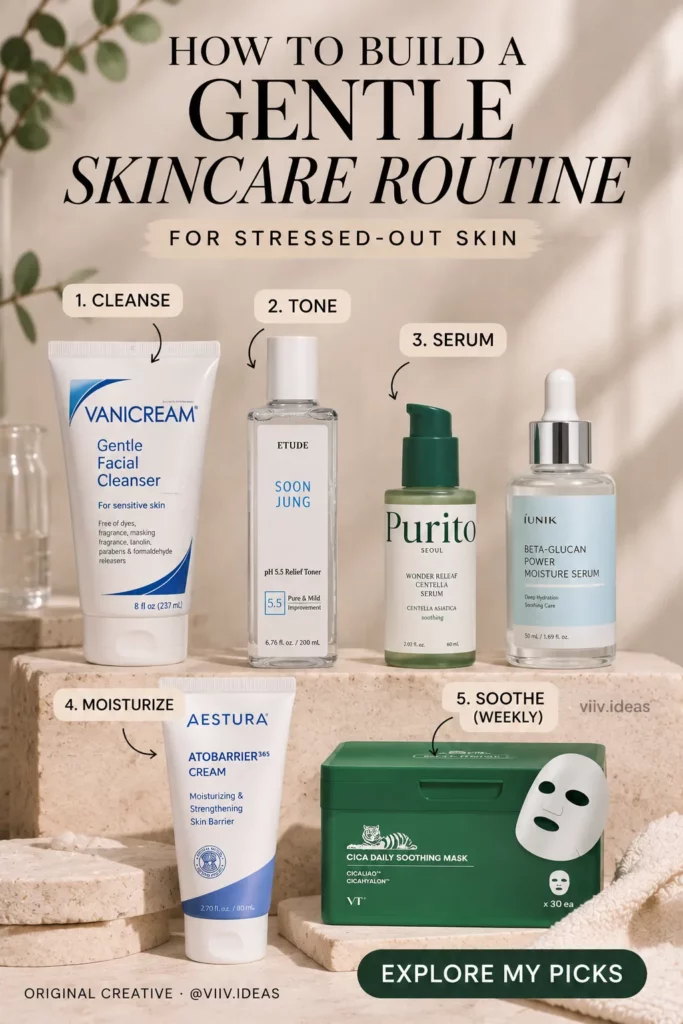
Morning Routine
Step 1: Cleanse gently
Start with a mild, fragrance-free cleanser and lukewarm water.
If your skin is particularly dry and you haven’t used heavy products overnight, simply rinsing with water may be sufficient for some people.
Avoid scrubbing, cleansing brushes, or harsh foaming products while your skin feels reactive.
Step 2: Add hydration if needed
A gentle hydrating toner or serum can be helpful, but neither is essential.
Look for products containing glycerin, beta-glucan, or panthenol, provided your skin tolerates them.
If your skin is severely irritated, skipping this step may actually be the better option.
If you enjoy lightweight, milky textures, I’ve also explored how these formulas work in my guide to milky toners, including why some are particularly appealing for dry and dehydrated skin.
If you prefer something a little more nourishing than a traditional watery toner, milky formulas are worth exploring. I covered their ingredients, textures, and benefits in my guide to milky toners, including how to choose one for dry or dehydrated skin.
Step 3: Apply a barrier-supporting moisturizer
This is arguably the most important moisturizing step.
Choose a formula suited to your skin type, ideally containing ingredients such as ceramides, glycerin, panthenol, or other emollients.
Apply it while your skin is still slightly damp to help retain moisture.
Step 4: Finish with sunscreen
Even when you’re simplifying your routine, sun protection remains important.
Choose a broad-spectrum SPF 30 or higher that your skin tolerates.
If your usual sunscreen stings, a fragrance-free mineral formula may be worth considering.
Evening Routine
Keep things equally simple.
- Remove sunscreen and makeup gently.
- Cleanse without scrubbing or using hot water.
- Apply an optional hydrating serum if tolerated.
- Finish with a suitable moisturizer.
If your skin is actively burning or irritated, consider temporarily pausing nonessential exfoliating acids, retinoids, and other potentially irritating actives. If an active product is prescribed for a medical condition, ask your clinician before stopping it.
Do You Need a Weekly Soothing Mask?
Not necessarily.
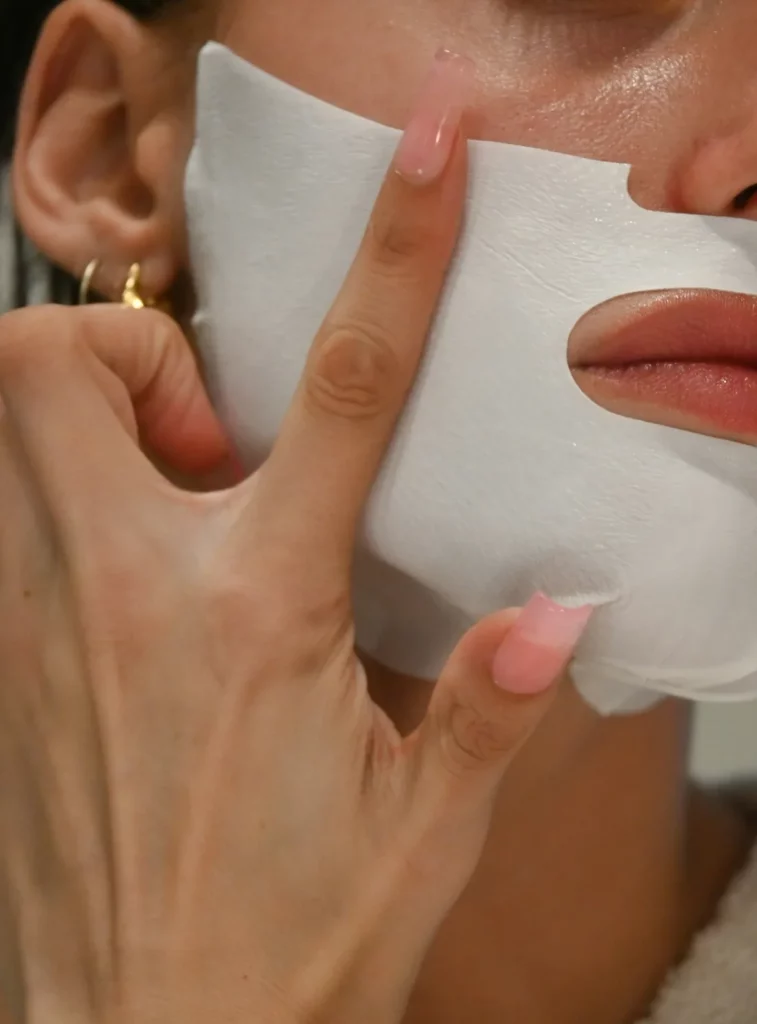
Sheet masks can feel refreshing and temporarily increase surface hydration, but they’re optional.
Some contain fragrances or botanical extracts that may irritate reactive skin.
Think of a soothing mask as an occasional extra, not a required repair treatment.
The simpler routine usually deserves priority.
5 Calming Moisturizers Worth Knowing
Finding a moisturizer for irritated skin can feel surprisingly complicated.
Should you choose a rich cream or a lightweight gel? Ceramides or panthenol? Something designed for dry skin or a formula that feels more comfortable under sunscreen?
There isn’t one universally perfect answer.
I’ve included five different options below, each with its own texture, ingredient focus, and potential advantages.
You can find these moisturizers and other gentle skincare options in my calming and soothing skincare collection on Amazon.

1. Aestura Atobarrier 365 Cream
Best for: Dry skin that needs a richer, barrier-focused moisturizer
Aestura Atobarrier 365 Cream has become a recognizable name in Korean barrier-focused skincare, largely because of its emphasis on moisturizing lipids.
The formula includes ceramide-related ingredients, cholesterol, glycerin, squalane, and other emollients that help soften skin and support moisture retention.
One of its distinctive features is its lipid-focused cream formulation, designed to provide lasting comfort without relying on an elaborate multi-step routine.
Why it’s interesting
Rather than focusing on exfoliation or aggressive treatment ingredients, this cream concentrates on maintaining moisture and supporting the skin’s protective barrier.
That makes it an appealing option for people experiencing dryness, tightness, or discomfort associated with environmental stress.
Texture and skin feel
Expect a substantial cream texture with a nourishing finish.
It may be particularly comfortable during colder months or as an evening moisturizer.
Things to consider
People with oily skin may find the texture richer than they prefer. The formula also contains niacinamide, which some highly reactive individuals may prefer to avoid when their skin is acutely irritated.
My take: A good option to consider when hydration disappears quickly and your skin seems to prefer substantial creams over lightweight gels.
2. Dr. Althea 147 Barrier Cream
Best for: Sensitive, dry skin that prefers a comforting cream texture
Dr. Althea 147 Barrier Cream takes a slightly different approach, combining moisturizing ingredients with barrier-focused components and botanical extracts.
Its formula includes ceramide NP, hydrogenated lecithin, and centella asiatica extract, among other ingredients.
The combination is designed around moisture retention and skin comfort.
Why it’s interesting
This moisturizer may appeal to people looking for a nourishing Korean skincare cream without adding several separate serums.
Ceramides contribute to the formula’s barrier-supporting approach, while emollient ingredients help reduce that uncomfortable dry feeling.
Texture and skin feel
It’s positioned as a rich moisturizer, making it particularly relevant for skin that feels tight or needs additional comfort.
Things to consider
Because the formula includes botanical ingredients, it’s still important to patch test, especially if your skin has reacted to plant extracts in the past.
Also, don’t confuse this moisturizer with Dr. Althea’s 345 Relief Cream. They’re different products with different formulations.
My take: Worth exploring if you want a moisturizing, barrier-focused cream and your skin generally tolerates more complex formulas.
3. Illiyoon Ceramide Ato Concentrate Cream
Best for: Very dry skin and people who prefer practical, generous-size moisturizers
Illiyoon Ceramide Ato Concentrate Cream is another well-known Korean moisturizer built around ceramide-focused skincare.
Compared with some smaller facial creams, it’s also commonly available in larger sizes, making it appealing for people who use moisturizer generously.
Why it’s interesting
Its main appeal is straightforward: a rich, protective moisturizing approach without needing several additional products.
A substantial emollient cream can be useful when dryness is the main concern and lightweight gels simply aren’t providing enough comfort.
Texture and skin feel
This is a richer, more substantial cream rather than a watery gel.
It can be particularly appealing for dry cheeks, winter dryness, or areas that feel rough and uncomfortable.
Things to consider
If your skin is oily or easily congested, you may prefer to use it selectively or choose a lighter texture.
Illiyoon formulas and packaging can vary by market or reformulation, so checking the current ingredient list is important.
My take: One to consider if you prefer a straightforward, generously sized moisturizer rather than building a complicated collection of skincare products.
4. Aveeno Calm + Restore Oat Gel Moisturizer
Best for: Sensitive skin that prefers lightweight hydration
Not everyone with sensitive skin enjoys thick creams.
Some people need a formula that feels soothing and hydrating without leaving a heavy finish.
That’s where Aveeno Calm + Restore Oat Gel Moisturizer becomes interesting.
Its formula features prebiotic oat and feverfew, ingredients associated with the brand’s sensitive skincare range.
Why it’s interesting
Oat-derived ingredients are particularly appealing in formulas designed for dry, uncomfortable skin.
Aveeno combines this approach with a lightweight gel-cream texture, offering an alternative to richer barrier creams.
Texture and skin feel
The texture is lighter and quicker absorbing than a traditional heavy cream.
This may make it more comfortable for combination skin or for daytime use beneath sunscreen.
Things to consider
Very dry skin may require a richer moisturizer, particularly in cold weather.
Also, while the product contains oat-derived ingredients, don’t assume it is identical to an over-the-counter colloidal oatmeal skin-protectant treatment.
My take: A practical option for someone who wants comfortable daily hydration without feeling like they’re wearing a thick layer of cream.
5. Purito Panthenol 10% Barrier Cream
Best for: Dehydrated, uncomfortable skin and panthenol-focused skincare routines
Purito’s panthenol-focused barrier cream stands out because of its emphasis on provitamin B5.
Panthenol is a useful moisturizing ingredient that can help improve skin hydration and support barrier function.
The 10% concentration is one of the defining features of this product family.
Why it’s interesting
While ceramide-focused products emphasize skin lipids, panthenol-based moisturizers offer another approach to hydration and skin comfort.
This makes a panthenol cream an interesting addition to a simplified routine, especially for people whose skin feels dehydrated or uncomfortable.
Texture and skin feel
It’s a moisturizing cream designed to provide hydration and comfort rather than exfoliation.
Depending on your skin type, it may work as a daily moisturizer or as a more focused option for dry areas.
Things to consider
Purito has updated products and packaging over time, so it’s important to verify which version you’re purchasing.
The currently marketed Mighty Bamboo Panthenol Cream, for example, is a different formulation from older Panthenol 10% Barrier Cream packaging.
My take: An appealing category of moisturizer if panthenol is an ingredient your skin already responds well to.
Which Moisturizer Should You Choose?
Rather than choosing the product with the most impressive ingredient list, think about what your skin actually needs.
| Your main concern | Moisturizer to consider |
|---|---|
| Persistent dryness and tightness | Aestura Atobarrier 365 Cream |
| Dry, sensitive skin seeking a rich cream | Dr. Althea 147 Barrier Cream |
| Very dry skin and generous everyday moisturizing | Illiyoon Ceramide Ato Concentrate Cream |
| Combination skin needing lighter hydration | Aveeno Calm + Restore Oat Gel Moisturizer |
| Dehydration and interest in panthenol | Purito Panthenol 10% Barrier Cream |
These are starting points, not guarantees. Your skin’s individual tolerance matters more than any product ranking.
Choosing the right moisturizer is one of the most important parts of a calming skincare routine. But the best formula depends on whether your skin needs lightweight hydration, richer emollients, or additional barrier support.
Everyday Habits That Can Make Irritated Skin Worse
Sometimes the problem isn’t that you’re missing an essential skincare ingredient.
It’s that your daily habits are making it harder for your skin to stay comfortable.
Overexfoliating
Exfoliating acids can be useful when applied appropriately, but using them too frequently may increase irritation.
If your skin is already stinging or peeling, adding another exfoliating product is unlikely to help.
Constantly Changing Products
Trying a new serum every few days makes it difficult to identify what’s helping and what’s causing problems.
Introduce products individually and give your skin time to respond.
Washing With Hot Water
Very hot water can worsen dryness and discomfort.
Lukewarm water is generally a better choice, particularly when your skin already feels sensitive.
Using Fragranced Products
Fragrance isn’t automatically harmful to everyone, but it can be a trigger for some people with reactive or allergy-prone skin.
A fragrance-free moisturizer is often a sensible place to start.
Ignoring Seasonal Changes
Cold outdoor air, indoor heating, and lower humidity can all contribute to dry skin.
A lightweight moisturizer that works beautifully in summer might not feel sufficient in winter.
I’ve covered this in more detail in my winter skincare guide, including practical adjustments that can help keep skin comfortable during colder months.
Cold weather can make an already uncomfortable skin situation even worse. If seasonal dryness is something you struggle with, my winter skincare guide covers the small routine adjustments that can help protect your skin during colder months.
The American Academy of Dermatology’s recommendations for relieving dry skin also emphasize gentle cleansing, fragrance-free moisturizers, and consistent hydration. Sometimes these basic habits make more sense than adding another complicated skincare step.
How Long Does It Take to Improve a Damaged Skin Barrier?
This is one of the most common questions, and the answer depends on what’s causing the irritation.
Mild dryness caused by overcleansing or temporary environmental stress may begin to feel better within several days of gentler care.
More significant irritation can take weeks, and an underlying condition may require specific treatment.
There isn’t a reliable universal timeline.
More importantly, skin feeling less tight doesn’t necessarily mean every aspect of its barrier function has fully recovered.
Consistency is usually more useful than constantly switching products in search of faster results.
Frequently Asked Questions About Calming Skincare
Can I use vitamin C or retinol when my skin barrier is damaged?
If your skin is actively burning, peeling, or unusually reactive, it may be sensible to temporarily pause nonessential potentially irritating products.
Once your skin feels comfortable again, reintroduce them gradually.
If you’re using a prescribed treatment, follow your dermatologist’s instructions.
Is hyaluronic acid good for irritated skin?
Hyaluronic acid is a humectant that helps attract and retain water.
It can be useful in a moisturizing routine, but it isn’t a complete replacement for a moisturizer containing emollient or occlusive ingredients.
Some very sensitive individuals may also react to particular formulations.
Are Korean skincare products better for sensitive skin?
Not automatically.
Korean skincare offers many gentle, hydration-focused formulations, but product suitability depends on the complete ingredient list, formulation, and your individual skin response.
Country of origin doesn’t guarantee tolerance.
Should I stop using all skincare products when my face is irritated?
Usually, the goal is to simplify rather than abandon skincare entirely.
A gentle cleanser when needed, a well-tolerated moisturizer, and suitable sun protection can form a basic routine.
However, significant or persistent symptoms deserve professional assessment.
Can oily skin have a damaged skin barrier?
Absolutely.
Oily skin can still experience dehydration, irritation, and barrier dysfunction.
Oil production and skin hydration aren’t the same thing.
A lightweight, well-tolerated moisturizer may be more comfortable than a heavy cream.
Are soothing sheet masks necessary?
No.
They can provide a temporary hydrating experience, but they’re not essential to barrier care.
If your skin is highly reactive, a simple moisturizing routine may be more predictable.
When should I see a dermatologist?
Seek medical advice if irritation is persistent, worsening, painful, repeatedly returning, or accompanied by significant swelling, crusting, or oozing.
These symptoms may require more than cosmetic skincare.
Final Thoughts: Sometimes Less Really Is More
The most effective calming skincare approach isn’t necessarily the one with the most products. It’s the one that helps your skin stay comfortable without constantly introducing new potential irritants.
A calming serum, a barrier cream, a soothing mask, and maybe three more things because someone on TikTok swears by them.
But the real solution is often much less exciting.
Cleanse gently. Moisturize consistently. Protect your skin from the sun. Stop pushing through irritation just because a product is supposed to be effective.
And most importantly, pay attention to what your own skin tolerates.
You don’t need every calming ingredient on the market. You need a routine that feels comfortable, supports hydration, and doesn’t leave your face feeling worse than before.
If you’re ready to simplify your routine, you can browse my curated calming and soothing skincare picks on Amazon for moisturizers and gentle skincare options worth considering.
Sometimes the best skincare upgrade is simply knowing when to do less.
This article is for educational purposes and does not replace professional dermatological advice. Product formulations may change, so always check current ingredients and patch test new products when appropriate.
Leave a Reply