Does your skin suddenly feel tight, irritated, or unusually sensitive, even though you haven’t changed much about your skincare routine?
Maybe your usual moisturizer starts to sting. Your face feels dry shortly after cleansing, or products you’ve used for months suddenly seem uncomfortable.
These changes can happen when the skin’s protective barrier isn’t functioning as effectively as it should.
But skin barrier damage isn’t always easy to recognize. Many of its possible symptoms overlap with common skin conditions, and not every instance of dryness or redness means your barrier is damaged.
Understanding what your skin barrier actually does, what can interfere with it, and how to care for irritated skin is a much better starting point than adding another product to your routine.
Here’s what you need to know.
What Is the Skin Barrier?
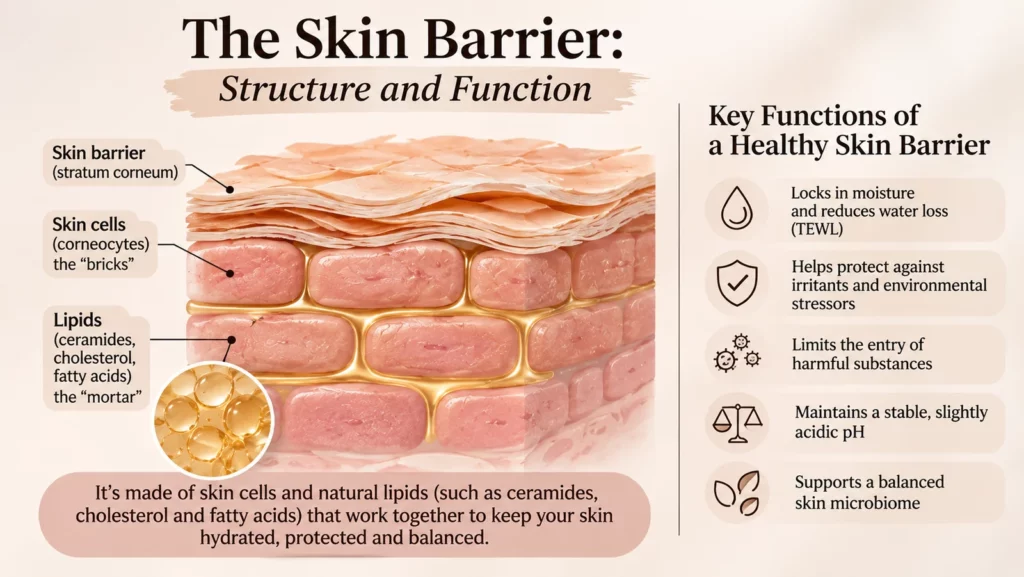
Your skin barrier is the outermost protective layer of your skin, primarily the stratum corneum.
It consists of flattened skin cells surrounded by a mixture of lipids, including ceramides, cholesterol, and fatty acids.
A useful way to understand this structure is to imagine a brick wall.
The skin cells act like bricks, while the lipids between them function like mortar, helping hold the structure together.
Together, they perform several essential functions:
- Reduce excessive moisture loss from the skin.
- Help protect against environmental irritants.
- Limit the entry of potentially harmful substances.
- Support a stable environment at the skin’s surface.
One important concept is transepidermal water loss (TEWL), which describes water moving from inside the body through the skin and evaporating into the environment.
Some water loss is normal. However, when the barrier is disrupted, more moisture may escape, contributing to dryness and irritation.
The skin barrier is also closely connected to the skin’s naturally acidic surface and microbiome, which play roles in maintaining normal skin function.
In short, a healthy skin barrier isn’t just about having soft or hydrated skin. It’s an important part of how your skin protects itself.
9 Possible Signs of Skin Barrier Damage
Skin barrier problems don’t look exactly the same on everyone.
Your skin type, environmental conditions, skincare habits, and underlying skin conditions can all affect how irritation appears.
The following signs may suggest that your skin’s protective function needs attention, but they are not a diagnosis.
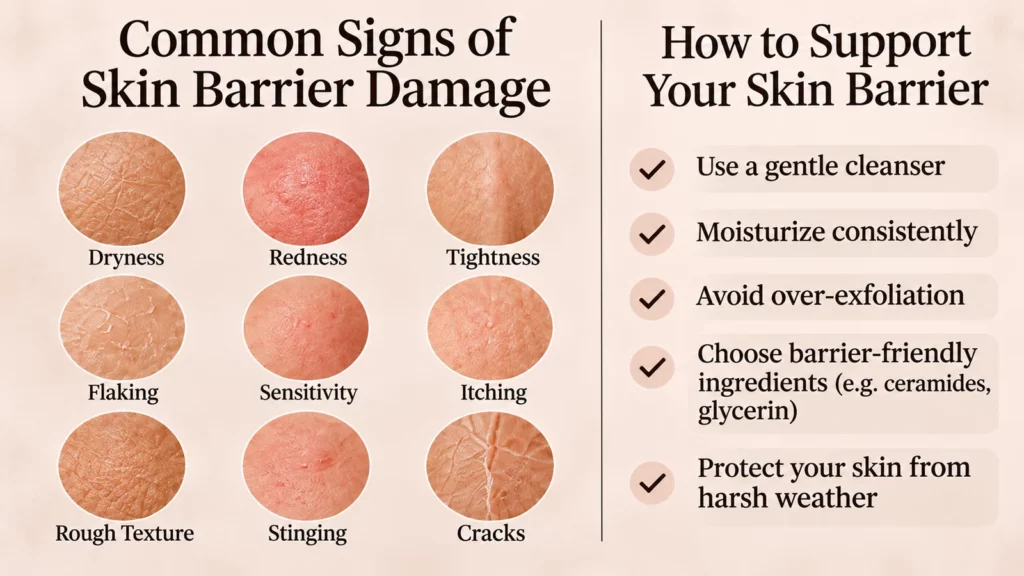
1. Persistent Dryness
Occasional dry skin is common, especially during winter.
However, skin that remains unusually dry despite regular moisturizing may indicate that its ability to retain moisture is compromised.
You might notice dry patches around your cheeks, forehead, or mouth, or feel that your skin becomes dry again soon after applying moisturizer.
Persistent dryness can also be associated with eczema and other dermatological conditions.
2. Tightness After Cleansing
Does your face feel uncomfortable or stretched immediately after washing?
This sensation can occur when cleansing removes too much of the skin’s natural oils or when a cleanser is too harsh for your skin.
A tight feeling doesn’t automatically indicate barrier damage, but repeated discomfort after cleansing is a reason to reconsider your cleansing routine.
Skin should feel clean without feeling stripped.
3. Stinging When Applying Skincare Products
One particularly noticeable warning sign is when products that previously felt comfortable begin to sting or burn.
Even a familiar moisturizer may suddenly cause discomfort.
This can occur when skin is irritated or its barrier function has been disrupted.
However, stinging can also be caused by an allergic or irritant reaction to a specific ingredient.
If a product repeatedly causes burning or irritation, stop using it and consider seeking professional advice.
4. Redness or Visible Irritation
Redness may appear alongside dryness, tightness, or sensitivity.
On deeper skin tones, irritation may look purple, brown, or darker than the surrounding skin rather than bright red.
Changes in skin color can result from inflammation, friction, irritating products, or underlying conditions such as rosacea or eczema.
Persistent or worsening discoloration deserves proper evaluation rather than being automatically labeled as barrier damage.
5. Rough or Uneven Texture
When skin becomes very dry, its surface may feel rougher than usual.
You might notice small dry patches, a less smooth texture, or areas that feel uncomfortable when touched.
It’s tempting to reach for an exfoliating product to smooth things out.
But if the texture is related to irritation, additional exfoliation can make the problem worse.
6. Flaking or Peeling
Visible flakes are often associated with dryness, but peeling can have several causes.
Cold weather, irritating skincare ingredients, sun exposure, and certain skin conditions can all contribute.
Repeated peeling, especially when accompanied by burning or redness, should not simply be treated with stronger exfoliation.
Sometimes the gentlest approach is the most appropriate one.
7. Increased Sensitivity to Products
Skin that previously tolerated multiple skincare products may start reacting more easily.
You might notice discomfort after applying a serum, sunscreen, or even products marketed for sensitive skin.
This doesn’t necessarily mean you’ve suddenly developed sensitive skin as a permanent skin type.
Temporary irritation can increase skin reactivity.
However, repeated reactions to specific products may also indicate contact dermatitis and should be assessed if they persist.
8. Itching or General Discomfort
Itching can accompany dry or irritated skin.
Scratching may further aggravate the area and interfere with recovery.
If itching becomes persistent, affects sleep, or is accompanied by a widespread rash, it’s important to consider causes beyond ordinary skincare irritation.
9. Cracking or Painful Dry Patches
Severely dry skin may eventually develop painful cracks.
These breaks in the skin deserve particular attention because they can increase discomfort and create an opportunity for infection.
Bleeding, oozing, spreading redness, increasing pain, or unusual warmth are reasons to seek medical assessment.
Important: Having several of these symptoms does not confirm skin barrier damage. A dermatologist can help identify whether irritation, eczema, rosacea, allergic contact dermatitis, or another condition is responsible.
What Causes Skin Barrier Damage?
The skin barrier is constantly responding to its environment.
Several factors may contribute to irritation or interfere with its normal protective function.
Over-Exfoliating
Exfoliating acids and physical scrubs can be useful in some skincare routines, but overusing them may cause irritation.
Combining multiple exfoliating products or increasing their frequency too quickly can be especially uncomfortable for sensitive skin.
More exfoliation does not necessarily mean healthier skin.
Using Too Many Active Ingredients
Retinoids, exfoliating acids, and some acne treatments can cause dryness or irritation, particularly when first introduced.
Using several potentially irritating products at once can make it difficult to identify which one is responsible.
This is why introducing new ingredients gradually is usually a more manageable approach.
If you’re unsure which products may be contributing to irritation, our Skincare Ingredients You Should Never Mix guide explains common ingredient combinations and how to approach them more carefully.
Harsh Cleansing Habits
Frequent washing, aggressive scrubbing, and cleansers that leave the skin feeling stripped may contribute to dryness.
Very hot water can also worsen dry skin.
A gentle cleansing routine is often more appropriate when the skin is already irritated.
Cold Weather and Low Humidity
Winter conditions can make existing dryness more noticeable.
Cold outdoor air, low humidity, and indoor heating may contribute to moisture loss and discomfort.
Our Winter Skincare Guide explores how to adapt your routine during colder months without making it unnecessarily complicated.
Underlying Skin Conditions
Not all barrier problems are caused by skincare mistakes.
Atopic dermatitis, for example, is associated with changes in skin barrier function.
Contact dermatitis and other inflammatory conditions can also cause persistent irritation.
When symptoms are recurring or difficult to control, changing moisturizers alone may not address the underlying cause.
How to Support Your Skin Barrier in 5 Steps
If your skin feels irritated, the most useful first step is often to simplify your routine.
The goal is to reduce potential irritants while supporting hydration and protecting your skin from further discomfort.
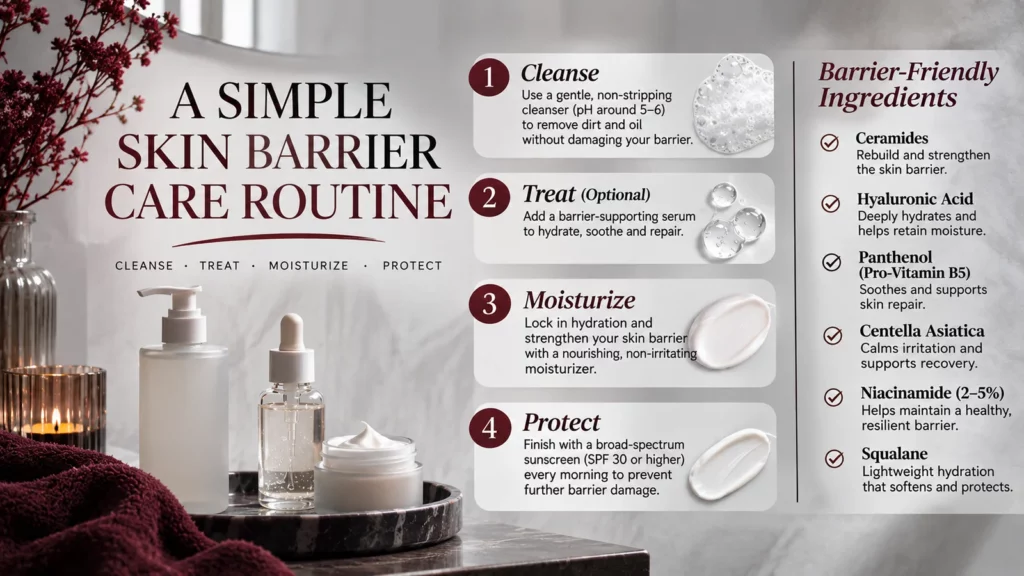
Step 1: Temporarily Simplify Your Routine
Consider pausing nonessential exfoliating acids, scrubs, and other products that appear to trigger irritation.
If you use a prescribed treatment, don’t discontinue it without discussing the situation with your healthcare professional.
You don’t necessarily need a complicated recovery routine.
A gentle cleanser, moisturizer, and appropriate sun protection may be sufficient as a starting point.
Step 2: Switch to Gentle Cleansing
Choose a mild, fragrance-free cleanser that doesn’t leave your face feeling tight.
Avoid aggressive scrubbing and use lukewarm rather than hot water.
For very dry skin, cleansing only when necessary may be more comfortable than repeatedly washing throughout the day.
Step 3: Moisturize Consistently
Moisturizers help reduce water loss and improve the comfort of dry skin.
Look for a formula that suits your skin type and doesn’t cause irritation.
Creams or ointments may offer more protection for very dry areas than lightweight lotions.
Applying moisturizer while the skin is still slightly damp can help maintain hydration.
Step 4: Protect Your Skin During the Day
Sun protection remains an important part of a balanced skincare routine.
Choose a broad-spectrum sunscreen with SPF 30 or higher that your skin tolerates comfortably, along with other sun-protective measures.
If your usual sunscreen causes irritation, consider discussing suitable alternatives with a dermatologist rather than abandoning sun protection altogether.
Step 5: Reintroduce Products Gradually
Once your skin feels more comfortable, avoid restarting every active ingredient at the same time.
Introduce products individually, allowing time to observe how your skin responds.
If irritation returns, stop the suspected product and reassess.
A simple routine that your skin tolerates well is more useful than a complicated routine you cannot comfortably maintain.
Which Ingredients Can Help Support the Skin Barrier?
Certain moisturizing ingredients are particularly useful because they support hydration or help reduce water loss.
The most important thing isn’t finding a product with every ingredient on this list. It’s finding a well-formulated moisturizer that your skin tolerates.
Ceramides
Ceramides are lipids naturally found in the outer layer of the skin.
They play an important role in maintaining the structure of the skin barrier.
Moisturizers containing ceramides may help support barrier function, particularly in dry or eczema-prone skin.
Glycerin
Glycerin is a humectant, meaning it attracts and helps retain water.
It’s widely used in moisturizers and can improve skin hydration.
Hyaluronic Acid
Hyaluronic acid is another humectant that helps bind water.
It can be a useful part of a moisturizing formula, although it isn’t a substitute for the other components that help limit moisture loss.
Petrolatum
Petrolatum is an occlusive ingredient that forms a protective layer over the skin, reducing water evaporation.
It can be particularly useful for very dry areas.
However, not every skin type or facial condition tolerates heavy occlusive products equally well.
Dimethicone
Dimethicone is a silicone-based ingredient commonly used in moisturizers.
It can help reduce moisture loss and improve the feel of a product on the skin.
Panthenol
Panthenol, also known as provitamin B5, is used in many moisturizing and soothing skincare formulas.
It can help improve hydration and comfort, although results depend on the overall product formulation.
If you enjoy lightweight, hydrating skincare, our Milky Toners Guide explains how these products fit into a routine. Just remember that a hydrating toner is optional, not an essential step in caring for irritated skin.
How Long Does Skin Barrier Recovery Take?
There isn’t one universal recovery timeline.
The time needed for skin to become comfortable again depends on the cause, severity, environmental conditions, and whether an underlying skin condition is present.
Mild irritation from an unsuitable skincare product may begin to settle after the trigger is removed.
More significant irritation or chronic conditions may require longer-term care and medical treatment.
Be cautious of claims that promise to completely repair your skin barrier in a specific number of days.
Skin doesn’t always follow a fixed schedule.
If symptoms persist, worsen, or repeatedly return despite gentle care, consult a dermatologist.
Common Skin Barrier Mistakes to Avoid
When your skin feels irritated, it’s easy to assume that adding more products will solve the problem.
But some popular skincare habits can make things more complicated.
Exfoliating away dry flakes. Flaking doesn’t always mean your skin needs exfoliation. If irritation is present, exfoliating may increase discomfort.
Using several new products at once. This makes it difficult to know what your skin can tolerate.
Assuming natural ingredients are always gentle. Botanical extracts, essential oils, and fragrances can also trigger irritation or allergic reactions.
Ignoring persistent symptoms. Ongoing redness, itching, or burning shouldn’t automatically be treated as a cosmetic problem.
Expecting one ingredient to fix everything. Ceramides and humectants can be helpful, but the effectiveness of a skincare routine depends on the whole formulation and the underlying condition.
Frequently Asked Questions
Can a Damaged Skin Barrier Cause Acne?
Barrier disruption and irritation can occur alongside acne, but breakouts alone don’t establish that the barrier is damaged. Acne has multiple causes, and some acne treatments can also lead to dryness or irritation. If you’re experiencing both, a dermatologist can help you balance acne treatment with skin comfort.
Should You Stop Retinol When Your Skin Barrier Is Damaged?
If an over-the-counter retinol product is causing significant irritation, temporarily stopping it may be sensible. If you use a prescription retinoid, ask your prescriber how to adjust your routine rather than stopping treatment without guidance.
Is Niacinamide Good for the Skin Barrier?
Niacinamide is commonly included in moisturizing products and has research supporting benefits for skin barrier function. However, some formulations may still irritate sensitive skin. The concentration and overall formulation matter.
Is Vaseline Good for a Damaged Skin Barrier?
Plain petrolatum can reduce water loss and help protect very dry skin. It isn’t necessarily the best choice for every facial condition, and it won’t treat an underlying infection or inflammatory skin disease on its own.
Can You Repair Your Skin Barrier Naturally?
Your skin has its own renewal processes. Gentle cleansing, appropriate moisturizing, avoiding unnecessary irritation, and protecting your skin from environmental stress can support normal recovery. You don’t need a collection of expensive products.
Final Thoughts
Your skin barrier plays an essential role in maintaining hydration and protecting your skin from everyday environmental stress.
When your skin becomes unusually dry, sensitive, or irritated, the answer isn’t always another serum or stronger treatment.
Sometimes it means paying attention to how your skin responds, removing unnecessary irritants, and returning to a simpler routine.
But remember that persistent irritation isn’t something you need to diagnose yourself.
Healthy skincare isn’t about using the most products or following every new trend.
It’s about understanding what your skin needs and choosing a routine that supports it.
Leave a Reply