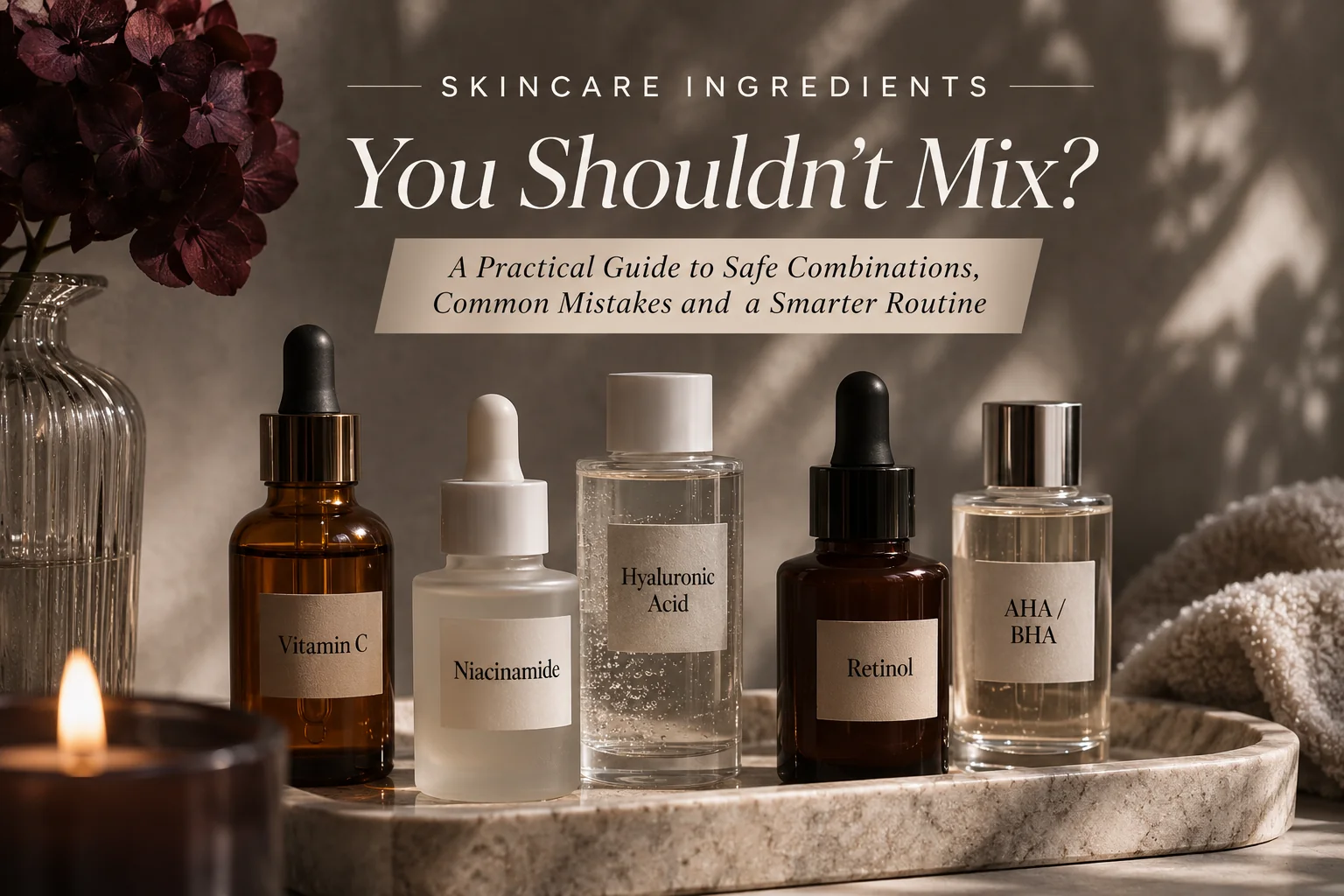
If you’ve ever watched three skincare videos and ended up convinced that half your products shouldn’t be used together, you’re not alone. Retinol, vitamin C, niacinamide, exfoliating acids… the rules can get confusing fast. But here’s what matters: some combinations can genuinely irritate your skin, while others have earned an unfair reputation.
Quick Answer: Which Skincare Ingredients Shouldn’t You Mix?
Some skincare ingredients require extra caution when used together, especially if they can both cause dryness or irritation. Retinoids combined with exfoliating acids are one common example.
Other combinations, such as vitamin C and niacinamide, are generally compatible, despite what you may have heard online.
The important thing to remember is that not every skincare combination is dangerous, and not every formula behaves the same way.
Concentration, product formulation, frequency of use, and your individual skin tolerance all make a difference.
Here’s a quick guide to some of the most commonly discussed combinations.
| Ingredient Combination | Compatibility | What You Should Know |
|---|---|---|
| Retinol + AHA/BHA | Use with caution | May increase irritation and dryness. |
| Benzoyl Peroxide + Tretinoin | Formulation-dependent | Some traditional tretinoin formulas are less stable with benzoyl peroxide. |
| Vitamin C + AHA/BHA | Use with caution | Not inherently incompatible, but potentially irritating. |
| AHA + BHA | Use with caution | Can work together, but overexfoliation is possible. |
| Retinol + Benzoyl Peroxide | Depends on the formula | May increase dryness; different retinoids behave differently. |
| Vitamin C + Niacinamide | Generally compatible | No universal need to separate them. |
| Hyaluronic Acid + Retinol | Generally compatible | Hydration may help with dryness associated with retinoid use. |
| Niacinamide + Salicylic Acid | Generally compatible | Often used together in oily and acne-prone skincare routines. |
| Ceramides + Retinoids | Generally compatible | Moisturizing ingredients can support skin comfort. |
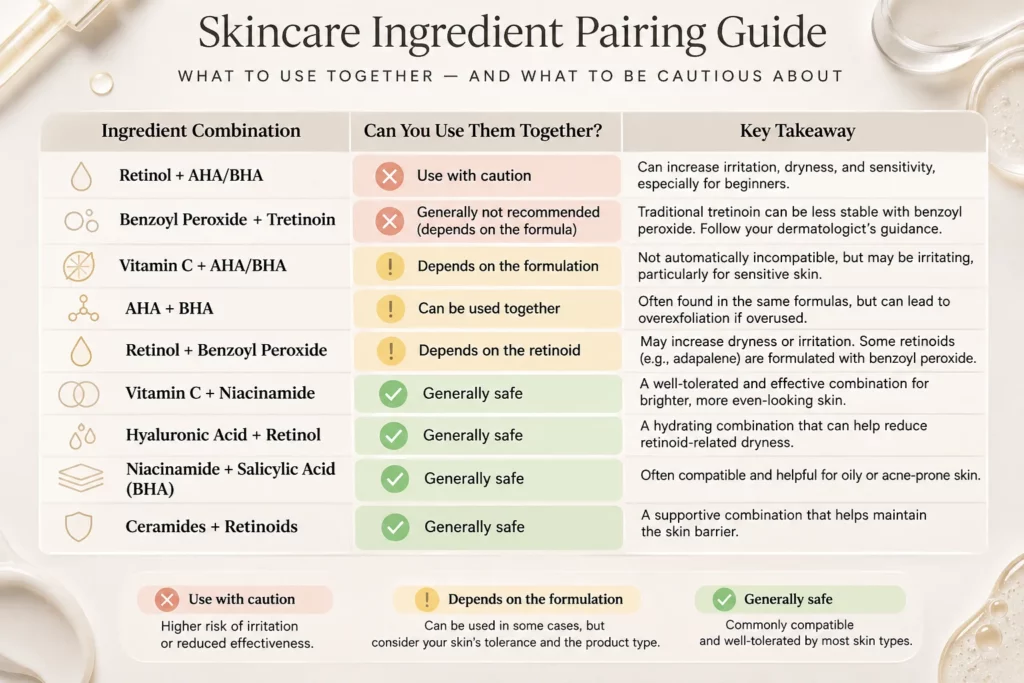
Not every caution means a combination is forbidden. This guide summarizes common concerns, but individual formulations and skin tolerance still matter.
Before you start rearranging your entire bathroom shelf, let’s look at why certain combinations deserve a little extra attention.
Why Some Skincare Ingredients Don’t Work Well Together
Not all skincare compatibility problems are the same.
Sometimes the issue is chemical stability. Other times, it’s simply that too many strong ingredients are being used at once.
Understanding the difference is much more helpful than memorizing a list of forbidden combinations.
1. Too Much Irritation at Once
Many popular active ingredients influence skin turnover, exfoliation, or acne-related processes.
Retinoids, glycolic acid, and salicylic acid can all be useful, but they may also cause dryness or irritation.
When several potentially irritating products are introduced together, your skin may struggle to tolerate the routine.
You might notice redness, tightness, flaking, or that uncomfortable stinging sensation when applying moisturizer.
This doesn’t automatically mean the products are incompatible. It may mean your routine is simply too aggressive for your skin.
2. Ingredient Stability
Some skincare ingredients can lose stability when exposed to certain conditions.
Light, oxygen, pH, packaging, and the surrounding formulation can all influence how a product performs.
A classic example involves certain tretinoin formulations and benzoyl peroxide.
Older research found that traditional tretinoin could degrade when combined with benzoyl peroxide, particularly under light exposure. However, later research showed that some optimized tretinoin formulations can remain stable under specific conditions.
You can explore this in the published research on tretinoin and benzoyl peroxide compatibility.
The takeaway? An ingredient’s name alone doesn’t tell you everything about its stability.
3. Your Skin’s Individual Tolerance
A routine that works for someone else might be completely wrong for you.
Someone with relatively resilient skin may tolerate a combination of active ingredients that leaves another person’s face red and uncomfortable.
Your skin type, existing conditions, and the amount of product you apply all matter.
If your skin is already feeling irritated, my Calming Skincare guide explains how the skin barrier works and which gentle ingredients may help restore comfort.
5 Skincare Ingredient Combinations to Use With Caution
Let’s get into the combinations that cause the most confusion.
None of these should automatically be treated as universally dangerous, but there are good reasons to approach them thoughtfully.
1. Retinol + AHA/BHA: The Irritation Risk
Retinol belongs to the retinoid family, while AHAs and BHAs are commonly used as exfoliating ingredients.
Popular AHAs include glycolic acid and lactic acid. Salicylic acid is the best-known BHA used in facial skincare.
Retinoids are commonly used to address acne, uneven texture, and visible signs of aging.
Exfoliating acids, meanwhile, help remove dead skin cells and can improve the appearance of rough texture or clogged pores.
Individually, both categories can be useful.
The problem begins when your skin can’t tolerate their combined effects.
Using retinol alongside a strong exfoliating acid may increase dryness, redness, flaking, and irritation, especially if you’re new to either ingredient.
That doesn’t mean they can never appear in the same skincare routine.
Dermatologists sometimes recommend carefully structured routines involving multiple active ingredients.
However, using a retinol serum and an exfoliating acid for the first time on the same evening is rarely a sensible starting point.
A better approach: introduce one active ingredient at a time. If both are appropriate for your skin, using them on different evenings may be easier to tolerate.
The American Academy of Dermatology’s guide to retinoids and retinol also recommends introducing retinoids gradually to help limit irritation.
2. Benzoyl Peroxide + Tretinoin: Formulation Matters
This pairing is slightly different because chemical stability can be a genuine concern.
Benzoyl peroxide is widely used in acne treatments, while tretinoin is a prescription retinoid.
Traditional tretinoin formulations can be susceptible to degradation when combined with benzoyl peroxide.
But modern skincare and dermatological formulations have made the situation more complicated than a simple yes-or-no answer.
Certain optimized formulations may remain stable, and other retinoids behave differently from tretinoin.
For example, adapalene and benzoyl peroxide are available together in established prescription acne treatments.
So, should you use benzoyl peroxide and tretinoin together?
Not without checking the specific products and treatment instructions.
If your dermatologist has prescribed both, follow the recommended schedule rather than trying to apply them together on your own.
Depending on the formulation, separating their application times may be appropriate.
The lesson here is that chemical compatibility depends on the actual formulation, not just a viral skincare rule.
3. Vitamin C + Exfoliating Acids: More Isn’t Always Better
Vitamin C is widely used for antioxidant support and for improving the appearance of uneven skin tone.
AHAs and BHAs are primarily used for exfoliation.
There’s no universal rule stating that vitamin C and exfoliating acids must never be used together.
However, combining a highly acidic vitamin C serum with an exfoliating product may increase irritation, particularly if your skin is sensitive.
You might notice stinging, redness, or unusual dryness.
Does separating them improve their effectiveness?
Not necessarily.
Using vitamin C in the morning and an exfoliating acid on selected evenings is mainly a practical way to simplify your routine and potentially improve tolerance.
It isn’t a chemical requirement that applies to every product.
If a vitamin C serum already feels uncomfortable on your skin, introducing an additional acid probably isn’t the best next step.
4. AHA + BHA: Be Careful With Double Exfoliation
Glycolic acid and salicylic acid are two of the most recognizable exfoliating ingredients.
Both can be useful, but they work differently.
AHAs are water-soluble and commonly used to improve the appearance of surface texture.
Salicylic acid is oil-soluble and is frequently used in products targeting clogged pores and acne-prone skin.
Some professionally formulated exfoliants combine AHAs and BHAs successfully.
So why the caution?
Because using multiple separate exfoliating products can make it easy to overdo things.
A glycolic acid toner followed by a salicylic acid serum and an exfoliating mask is probably more exfoliation than many people need.
Signs of overexfoliation may include persistent dryness, flaking, redness, and sensitivity.
And there’s another reason to be careful: some AHAs can increase the skin’s sensitivity to sunlight.
The U.S. Food and Drug Administration’s information on alpha hydroxy acids explains this concern in more detail.
A better approach: follow the product’s instructions, avoid introducing several exfoliants simultaneously, and prioritize sun protection.
5. Retinol + Benzoyl Peroxide: Not a Universal No
You’ll often see retinol and benzoyl peroxide listed as ingredients that should never appear together.
But once again, the answer depends on the products.
Retinol is an over-the-counter cosmetic retinoid, while benzoyl peroxide is commonly used to treat acne.
Both may cause dryness or irritation, particularly when used frequently.
And although some traditional retinoid formulations have known stability concerns with benzoyl peroxide, the same rule cannot be applied to every retinoid.
The practical takeaway: don’t add retinol to an existing benzoyl peroxide acne routine simply because both ingredients are popular.
Consider whether you actually need both.
If your acne is being treated with prescription medication, check with your dermatologist before adding additional active ingredients.
Skincare Ingredient Combinations That Are Actually Fine
Now for the combinations that have developed a reputation they don’t necessarily deserve.
Some ingredients work perfectly well together in properly formulated products.
Others can complement each other by addressing different skincare concerns.
1. Vitamin C + Niacinamide
This is probably one of the most persistent skincare myths.
For years, people were told that vitamin C and niacinamide would cancel each other out or become ineffective when used together.
But modern cosmetic formulations can contain both ingredients, and there’s no general rule requiring them to be separated.
Vitamin C is commonly used for antioxidant support and improving the appearance of uneven skin tone.
Niacinamide may help support the skin barrier, improve the appearance of pigmentation, and reduce visible oiliness.
Can you use them together?
Generally, yes.
The real concern is whether your skin tolerates the individual products, especially if your vitamin C serum is highly acidic.
You also don’t need to combine them to get results. A well-formulated product containing one ingredient may already address your concerns.
2. Hyaluronic Acid + Retinol
This combination makes practical sense.
Retinoids can cause dryness, particularly during the first weeks of use.
Hyaluronic acid is a humectant, which means it helps attract and retain water in the skin.
A hydrating serum or moisturizer can make a retinoid routine feel more comfortable.
However, hyaluronic acid isn’t a substitute for a complete moisturizer.
Creams containing emollients and occlusive ingredients may provide additional support for dry skin.
3. Niacinamide + Salicylic Acid
These ingredients are generally compatible.
Salicylic acid is commonly used to help address clogged pores.
Niacinamide can support skin barrier function and improve the appearance of excess oiliness.
Because they serve different purposes, using them in the same routine isn’t automatically problematic.
That said, salicylic acid can still be irritating depending on its concentration and frequency of use.
If you’re sensitive to exfoliating products, start slowly.
4. Ceramides + Retinoids
Ceramides are naturally occurring lipids that contribute to the structure of the skin’s protective barrier.
Retinoids, meanwhile, may cause dryness and irritation.
Using a moisturizer containing ceramides alongside a retinoid can help support hydration and skin comfort.
It won’t guarantee that you avoid irritation, but it can be a useful part of a well-balanced routine.
And unlike many active treatments, ceramide-based moisturizers don’t need to be reserved for a particular time of day.
How to Layer Skincare Ingredients Correctly
One of the easiest ways to make skincare less confusing is to stop treating every ingredient like a separate requirement.
You don’t need a vitamin C serum, niacinamide serum, exfoliating toner, retinol treatment, and three different moisturizers to have an effective routine.
Start with the basics, then add targeted products based on your concerns.
A Simple Morning Skincare Routine
Step 1: Gentle cleanser
Choose a cleanser suited to your skin type that doesn’t leave your face feeling excessively tight or uncomfortable.
Step 2: Vitamin C serum (optional)
Vitamin C is often used in the morning as part of an antioxidant-focused routine.
It’s optional, not a requirement for healthy skin.
Step 3: Moisturizer
Look for ingredients such as glycerin, ceramides, or hyaluronic acid, depending on your skin’s needs.
If you enjoy lightweight, hydrating products, I’ve also explored how different formulas work in my guide to milky toners, including when they can be useful for dry or dehydrated skin.
Step 4: Broad-spectrum SPF 30 or higher
Daily sun protection is particularly important when using exfoliating acids or other potentially irritating treatments.
A Simple Evening Skincare Routine
Step 1: Gentle cleanser
Remove sunscreen, makeup, and daily buildup without aggressively scrubbing your skin.
Step 2: Retinoid, if appropriate
Use a retinoid according to its instructions or your dermatologist’s recommendations.
Beginners may need to introduce it gradually.
Step 3: Moisturizer
A well-tolerated moisturizer can help reduce dryness and maintain comfort.
On evenings when you’re using an exfoliating acid, you may prefer not to use a retinoid as well, particularly if your skin is sensitive.
Remember that these are example routines. You don’t need retinol or vitamin C simply because they’re popular.
What Happens When You Use Too Many Active Ingredients?
Sometimes the biggest problem isn’t one ingredient. It’s the entire routine.
A glycolic acid toner, a retinol serum, an exfoliating cleanser, and a new acne treatment might all sound reasonable individually.
But when they’re introduced together, identifying the cause of irritation becomes difficult.
Your skin may start feeling dry, tight, red, or unusually sensitive.
People often describe this as a damaged skin barrier.
While barrier dysfunction can contribute to these symptoms, persistent irritation may also involve contact dermatitis, eczema, rosacea, or other skin conditions.
What to Do If Your Skin Feels Overwhelmed
1. Pause unnecessary active ingredients.
If your skin feels irritated, consider temporarily stepping away from nonessential exfoliating or cosmetic treatments. Ask your dermatologist before changing prescribed treatments.
2. Cleanse gently.
Avoid facial scrubs, harsh cleansers, and very hot water.
3. Focus on moisturizing.
A fragrance-free moisturizer with humectants, emollients, and barrier-supporting lipids can help relieve dryness.
4. Protect your skin from sunlight.
Use a broad-spectrum sunscreen that your skin tolerates.
5. Stop constantly introducing new products.
Give your routine time to settle before adding something else.
For a deeper explanation of how to care for uncomfortable, reactive skin, my Calming Skincare guide covers soothing ingredients and simple barrier-supporting routines.
Does Cold Weather Change How Your Skin Reacts to Active Ingredients?
It can.
Cold outdoor temperatures, low humidity, and indoor heating can contribute to dryness and discomfort.
When your skin is already dry, certain exfoliating acids or retinoids may become harder to tolerate.
That doesn’t mean everyone needs to stop using active ingredients during winter.
It simply means your routine may need adjusting.
A richer moisturizer, a gentler cleanser, or less frequent exfoliation may help.
I’ve explored these seasonal adjustments in more detail in my winter skincare guide, including practical ways to keep skin comfortable during colder months.
The goal isn’t to follow exactly the same routine every day of the year.
It’s to pay attention to what your skin actually needs.
Frequently Asked Questions About Mixing Skincare Ingredients
Can I use retinol and vitamin C together?
Yes, some people tolerate both ingredients in the same routine.
However, either product may cause irritation depending on its formulation.
Using vitamin C in the morning and a retinoid in the evening is a practical approach, but not a universal chemical requirement.
Can I use niacinamide with AHA or BHA?
Generally, yes.
Niacinamide is compatible with many exfoliating products.
However, a strong exfoliating acid may still irritate your skin regardless of whether niacinamide is present.
Can I use salicylic acid and retinol on the same night?
Some people tolerate the combination, but it may increase dryness or irritation.
If you’re new to either ingredient, using them on different evenings may be more comfortable.
Follow medical guidance when using prescription acne treatments.
Can hyaluronic acid and vitamin C be used together?
Yes.
These ingredients are generally compatible.
Hyaluronic acid helps support hydration, while vitamin C is commonly used for antioxidant benefits.
How many active skincare ingredients should I use?
There’s no ideal number that works for everyone.
Your routine should depend on your skin concerns, tolerance, and whether you’re using medical treatments.
More active ingredients don’t automatically mean better results.
Should I introduce new skincare products one at a time?
Yes, particularly if your skin is sensitive or reactive.
Introducing products individually can make it easier to identify possible triggers.
The American Academy of Dermatology recommends testing new skincare products before incorporating them into your routine.
Keep in mind that a successful home test doesn’t guarantee a product will never cause irritation.
What should I do if a skincare product burns my face?
If a product causes significant burning, wash it off and stop using it.
Avoid applying additional strong active ingredients in an attempt to correct the reaction.
If symptoms are severe, persistent, or accompanied by swelling, blistering, or significant pain, seek medical attention.
Can I use AHA and BHA products every day?
That depends on the concentration, formulation, product instructions, and your skin’s tolerance.
Some gentle products are intended for regular use, while stronger exfoliants require less frequent application.
Daily exfoliation isn’t necessary for everyone.
Do I need to wait between applying different skincare ingredients?
Not necessarily.
For many cosmetic products, there’s no scientific requirement to wait a specific number of minutes between layers.
Allowing a product to settle can make application more comfortable, but strict waiting rules don’t apply universally.
Follow the manufacturer’s instructions or your dermatologist’s advice when using prescription treatments.
Final Thoughts: More Skincare Doesn’t Always Mean Better Skin
There’s something tempting about adding another serum to your skincare routine.
You hear about a new ingredient, read a glowing review, and suddenly it feels like the missing piece.
But effective skincare isn’t about collecting as many active ingredients as possible.
It’s about understanding what you’re using, choosing products that address your actual concerns, and giving your skin time to respond.
Some combinations genuinely require caution. Others are perfectly reasonable and have simply been misunderstood.
The most useful skincare rule isn’t “never mix these ingredients.”
It’s much simpler: understand your products, pay attention to irritation, and don’t make your routine more complicated than it needs to be.
Your skin doesn’t need to follow every trend. It needs a routine that works for you.
Disclaimer: This article is for educational purposes only and does not replace professional dermatological advice. Individual skin reactions vary, and prescription skincare treatments should be used according to medical guidance.
Leave a Reply