Milky toners are having a moment in Korean skincare, and there’s a good reason people keep adding them to their routines. These lightweight, creamy formulas promise a little more comfort than traditional watery toners, without the heaviness of a rich moisturizer. But what do they actually do for your skin, and are they worth trying?
Amazon Associates Disclosure
As an Amazon Associate I earn from qualifying purchases.
If you’re curious about the different formulas, I’ve put together a collection of milky toners and hydrating essences worth exploring. It includes everything from lightweight Korean skincare favorites to richer, barrier-focused options.
What Exactly Is a Milky Toner?
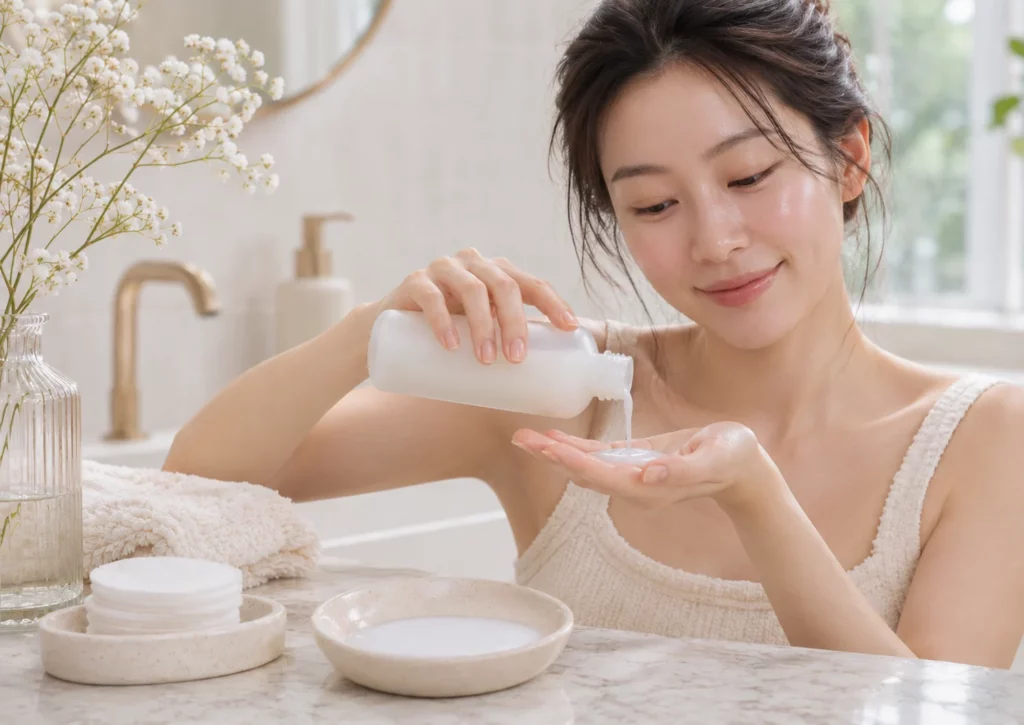
Think of a milky toner as the middle ground between a traditional facial toner and a lightweight lotion.
Unlike the clear, watery toners many of us grew up using, milky toners have a soft, cloudy appearance and a slightly more substantial texture. This often comes from combining water-based ingredients with emollients, oils, or other skin-conditioning ingredients in an emulsion.
The result is a product that can deliver hydration while making the skin feel softer and more comfortable.
But here’s something worth knowing: milky toner isn’t a strictly defined scientific category. It’s mainly a description of the product’s texture and how it’s intended to fit into a skincare routine.
Two milky toners can look almost identical in the bottle while having very different ingredient lists.
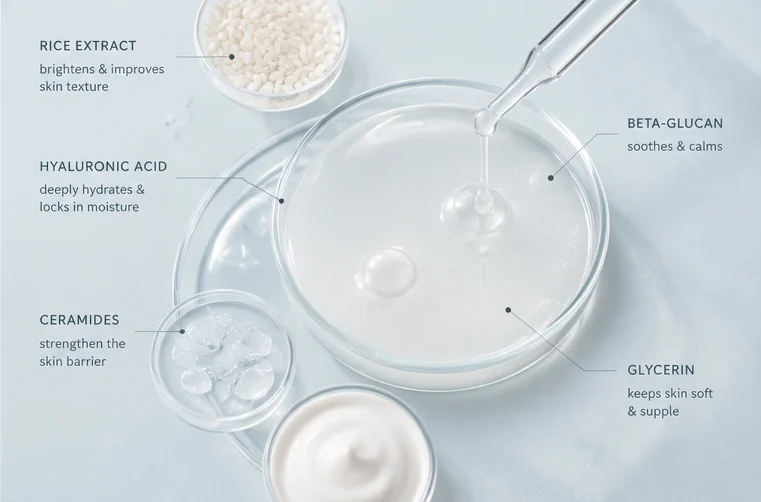
One might focus on humectants such as glycerin and hyaluronic acid. Another may contain ceramides, squalane, and other lipids that help support the skin’s moisture barrier.
That difference matters far more than the milky appearance itself.
Why Are Milky Toners So Popular in Korean Skincare?
One of the most recognizable ideas associated with Korean skincare is building hydration gradually rather than relying on a single heavy product.
A typical K-beauty-inspired routine might include a gentle cleanser, hydrating toner, essence, serum, moisturizer, and sunscreen, although you certainly don’t need every step to have healthy skin.
Milky toners fit into this approach beautifully because they make it easy to add a comfortable, moisturizing layer without immediately reaching for a thick cream.
They also appeal to anyone chasing the popular glass skin look: skin that appears smooth, hydrated, fresh, and naturally luminous.
Of course, glass skin is more of a beauty aesthetic than a medical outcome. No toner can eliminate pores, erase texture, or give everyone the same complexion.
What a well-formulated milky toner may do is improve surface hydration and temporarily make the skin appear softer and more supple.
And sometimes, that’s exactly what a skincare routine needs.
The Science Behind Milky Toners: How Do They Actually Work?
This is where milky toners become more interesting than their pretty packaging.
To understand how they work, we first need to talk about the skin barrier.
Understanding Your Skin Barrier
Your skin’s outermost layer is called the stratum corneum. It’s made up of skin cells surrounded by a complex mixture of lipids, including ceramides, cholesterol, and fatty acids.
A useful way to picture this structure is a brick wall: the skin cells are the bricks, while the surrounding lipids help hold everything together.
One of the barrier’s most important jobs is helping the skin retain water while limiting the entry of potential irritants.
When this protective system isn’t functioning optimally, skin may feel tight, rough, flaky, or uncomfortable.
Scientists often evaluate this function by measuring transepidermal water loss, or TEWL, which refers to water moving through the skin and evaporating from its surface.
Research published in Skin Pharmacology and Physiology explains how different moisturizing ingredients can support skin barrier function through complementary mechanisms.
You can read the scientific review on skin barrier function and moisturization here.
Humectants: Ingredients That Help the Skin Hold Water
Humectants are ingredients that attract and bind water.
Some of the most common examples in skincare include:
- Glycerin: A widely used humectant that helps increase water content in the outer skin layers.
- Hyaluronic acid: A water-binding ingredient that can help skin feel hydrated and temporarily appear plumper.
- Panthenol: Also known as provitamin B5, commonly used for its moisturizing and skin-conditioning properties.
- Beta-glucan: A polysaccharide used in skincare for its water-binding and conditioning properties.
When a milky toner contains these ingredients, it can contribute an additional layer of hydration to your routine.
However, hydration isn’t simply about adding water. It’s also about helping prevent excessive moisture loss.
Ceramides and Emollients: Supporting the Moisture Barrier
Ceramides are naturally occurring lipids that help maintain the structure of the skin’s outer protective layer.
Alongside cholesterol and fatty acids, they contribute to the organized lipid structures that limit water loss.
A scientific review published in the International Journal of Cosmetic Science discusses the role of ceramides in skin barrier function and explains why proper formulation matters.
For a deeper explanation, see the research review on ceramides and their role in the skin barrier.
Some milky toners also contain emollient ingredients such as squalane, meadowfoam seed oil, or other skin-conditioning lipids.
These help soften the skin’s surface and can reduce the dry, uncomfortable feeling that sometimes remains even after applying a watery serum.
The important distinction is that ingredient research doesn’t automatically prove the effectiveness of every product containing that ingredient.
The concentration, formulation, stability, and overall combination of ingredients all influence how a finished toner performs.
What About Rice, Oats, and Fermented Ingredients?
Rice extracts, oat-derived ingredients, and ferments appear frequently in modern Korean skincare.
Rice-based formulas are often marketed for radiance and smoother-looking skin, although their effects depend on the individual formulation.
Oat-derived ingredients are particularly interesting in products focused on dry or uncomfortable skin. Colloidal oatmeal, for example, has a history of use in skin-protective and moisturizing formulations.
Fermented extracts are another popular category. They can provide skin-conditioning compounds, but the term fermented doesn’t automatically mean a product is more effective.
There is still a difference between promising ingredient research and well-established clinical evidence for a specific cosmetic formula.
The takeaway? Look beyond the trending ingredient on the label and pay attention to the whole formula.
5 Benefits of Milky Toners for Your Skin
1. They Can Improve Surface Hydration
A well-formulated milky toner can help replenish moisture after cleansing, particularly when it contains glycerin, hyaluronic acid, or other humectants.
This may make the skin feel less tight and appear more supple.
2. They Can Support the Skin’s Moisture Barrier
Formulas containing ceramides and emollients can complement a barrier-focused routine.
They shouldn’t be viewed as a treatment for a diagnosed skin condition, but they may be helpful cosmetic additions for skin experiencing everyday dryness.
3. They Leave Skin Feeling Softer
The combination of humectants and emollients can create that smooth, cushioned feeling people associate with milky toners.
This is particularly appealing if traditional watery toners seem to disappear without leaving much comfort behind.
4. They Can Make Dry-Looking Skin Appear More Radiant
Hydrated skin often reflects light more evenly, which can create a fresher, dewier appearance.
It’s a temporary cosmetic improvement rather than a permanent change in skin texture, but it can still make a noticeable difference in how makeup sits on the skin.
5. They Add Flexibility to Your Routine
You can use a milky toner as a simple hydration step or pair it with a serum and moisturizer.
Some richer formulas may even be enough for certain skin types during humid weather, while others work better as an additional layer beneath a cream.
Who Should Use a Milky Toner?
The short answer: potentially almost anyone, as long as the formula suits their skin.
Dry skin: Look for a combination of humectants and emollient ingredients. Ceramides, squalane, and nourishing lipids may be particularly useful.
Dehydrated skin: Focus on ingredients such as glycerin, hyaluronic acid, panthenol, and beta-glucan. Remember that dehydration describes a lack of water, while dry skin generally refers to insufficient oil or lipids.
Combination skin: A lightweight milky toner can provide hydration without requiring a rich moisturizer across the entire face.
Oily or acne-prone skin: You don’t necessarily need to avoid milky toners. Choose a lighter formula, introduce it gradually, and pay attention to how your skin responds.
Sensitive skin: Prioritize simple, well-tolerated formulas and check the complete ingredient list. Fragrance-free products may be preferable, but they can still cause reactions.
If your skin is persistently inflamed, cracked, or extremely irritated, adding another cosmetic product isn’t necessarily the answer. A dermatologist can help identify what’s causing the problem.
How to Use a Milky Toner in Your Skincare Routine
One of the nicest things about milky toners is how little effort they require.
You don’t need a complicated ten-step routine or a special application technique.
Here’s an easy approach:
Step 1: Cleanse gently. Use a cleanser suited to your skin and avoid stripping it with excessively harsh washing.
Step 2: Apply the milky toner. Pour a small amount into clean hands and gently spread or press it over your face. A cotton pad is also an option if the manufacturer’s directions recommend it.
Step 3: Add a serum if you use one. Hydrating serums, niacinamide, and other treatments can often fit comfortably into the same routine.
Step 4: Finish with moisturizer. This is especially important if your skin is dry or you need additional protection against moisture loss.
Step 5: Apply sunscreen in the morning. Use a broad-spectrum SPF 30 or higher as the final skincare step before makeup.
Start with one layer of toner. If your skin tolerates it and needs more hydration, you can experiment with additional thin layers.
There’s no requirement to apply seven layers, and using more product doesn’t automatically produce better results.
Morning or Evening?
Both can work.
In the morning, a lightweight milky toner may create a comfortable base beneath moisturizer, sunscreen, and makeup.
At night, a richer formula can complement a routine focused on replenishing moisture after cleansing.
Choose based on your skin’s needs rather than following a strict rule.
What Skincare Ingredients Can You Combine With Milky Toners?
A basic, hydrating milky toner can work alongside many common skincare ingredients.
But whether two products work well together depends on their complete formulas, not just their category names.
Milky Toners + Hyaluronic Acid
A useful combination for dehydrated skin.
Both products can contribute hydration, although you may find that a good milky toner already provides enough moisture on its own.
You don’t need multiple hyaluronic acid products simply because they’re popular.
Milky Toners + Niacinamide
Niacinamide is commonly used in routines focused on uneven skin tone, excess oil, and overall skin condition.
A hydrating milky toner can complement a niacinamide serum, but check whether your toner already contains niacinamide before adding another product.
More isn’t always better.
Milky Toners + Vitamin C
These can generally be used in the same routine, depending on the formulas and your tolerance.
If you use a low-pH vitamin C serum, follow its application instructions and introduce new products gradually.
A milky toner isn’t required to make vitamin C effective.
Milky Toners + Retinoids
A gentle moisturizing toner may help make a retinoid routine more comfortable.
However, it won’t prevent every type of irritation.
If you’re particularly sensitive, consider a simple routine using moisturizer before or after your retinoid, depending on the product instructions and professional advice.
Avoid introducing several new active products at once.
Milky Toners + AHA or BHA Exfoliants
They can work together, but the toner should not be viewed as permission to exfoliate more frequently.
If you’re experiencing burning, persistent redness, or peeling, reduce irritating products and focus on a gentle routine.
Also check whether your milky toner contains exfoliating ingredients of its own.
Milky Toners + Ceramide Moisturizers
This is a particularly practical pairing for dry skin.
The toner can provide hydration and a softening layer, while a well-formulated moisturizer can supply additional emollient and protective ingredients.
For many people, the combination is more useful than applying multiple layers of toner alone.
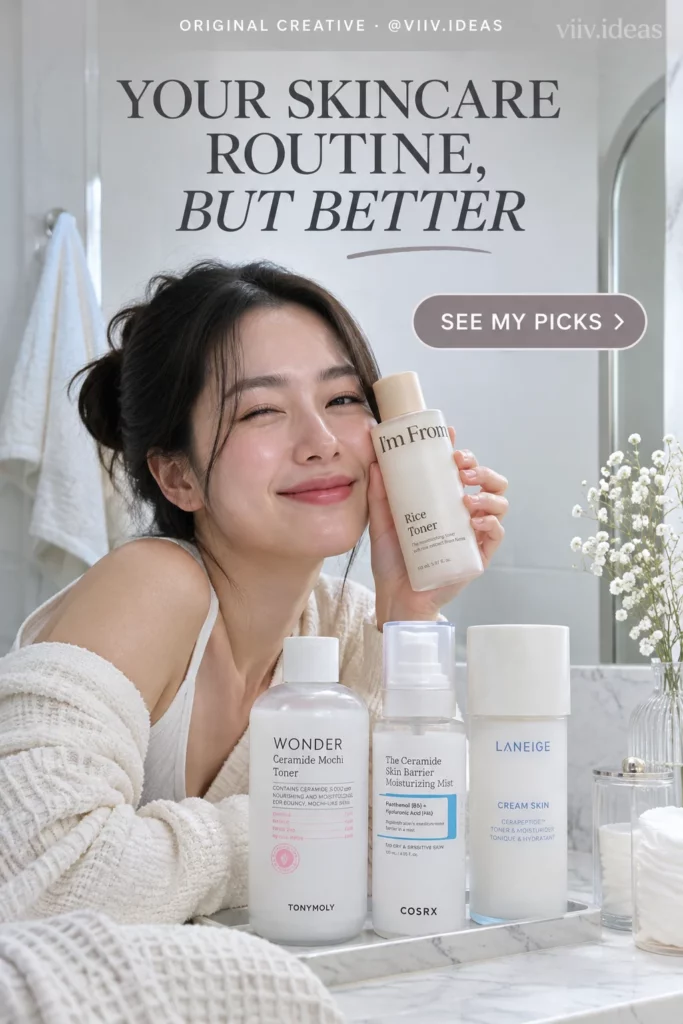
You don’t have to rebuild your entire skincare routine to explore this category. I’ve collected a range of milky toners and essences in my Amazon skincare edit, so you can compare lighter options with more nourishing formulas before deciding what your skin actually needs.
6 Milky Toners & Essences Worth Trying
There isn’t one perfect milky toner for every skin type.
Some formulas are designed for lightweight hydration, while others focus on richer, barrier-supporting ingredients.
For this edit, I’ve selected six different approaches, including Korean skincare favorites and two non-Korean alternatives that fit the same moisturizing category.
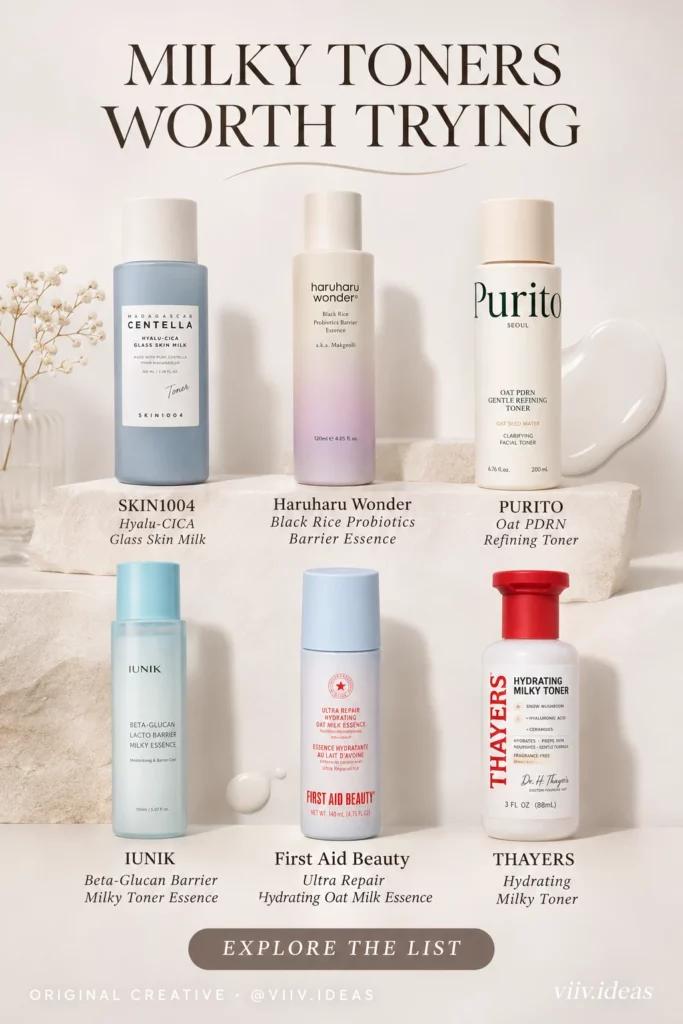
1. SKIN1004 Hyalu-Teca Glass Skin Milk
Best for: Normal, dry, and dehydrated skin; anyone who prefers a dewy finish.
If you’re drawn to Korean skincare for that fresh, luminous complexion, SKIN1004’s Glass Skin Milk is an interesting place to start.
Despite its rich-looking, milky appearance, the formula is designed to feel relatively lightweight.
It combines sodium hyaluronate with centella asiatica-derived compounds, glycerin, niacinamide, panthenol, and additional skin-conditioning ingredients.
These ingredients give the formula a combination of moisturizing and complexion-focused properties.
It also contains gluconolactone, a polyhydroxy acid, or PHA, commonly used for gentle exfoliating effects. The presence of PHA is worth remembering if you already use exfoliating treatments.
What makes this product appealing is its balance between a hydrating essence and a lightweight lotion.
It’s a reasonable option for someone who wants softer-looking skin and a luminous finish without immediately applying a heavy moisturizer.
Why it stands out: It combines hydration-focused ingredients with components associated with smoother-looking skin and radiance.
Worth knowing: Sensitive skin types should still introduce it carefully, particularly if their routine already contains exfoliating acids.
2. Haruharu Wonder Black Rice Probiotics Barrier Essence
Best for: Dry skin, moisture-depleted skin, and anyone who prefers a richer essence.
If your skin tends to feel tight shortly after cleansing, Haruharu Wonder’s Black Rice Probiotics Barrier Essence is worth considering.
This formula takes a more nourishing approach than a typical watery toner.
Alongside black rice extract and fermented ingredients such as galactomyces and bifida ferment filtrates, it contains sunflower seed oil, meadowfoam seed oil, squalane, panthenol, and several ceramides.
The combination is particularly interesting from a moisturizing perspective.
Humectants help provide hydration, while oils and emollient lipids contribute softness and a more comfortable finish.
The formula also contains cholesterol and fatty acids, ingredient categories relevant to the structure of the skin barrier.
Rather than treating it as a product that can magically repair damaged skin overnight, think of it as an additional moisturizing layer in a consistent routine.
It may be especially appealing during colder weather or when lightweight toners don’t provide enough comfort.
Why it stands out: Its combination of ceramides, lipids, and moisturizing ingredients makes it one of the more nourishing options in this collection.
Worth knowing: Richer formulas aren’t automatically better. If your skin is oily or you dislike the feeling of emollient products, you may prefer something lighter.
3. PURITO Oat PDRN Gentle Refining Toner
Best for: Normal, combination, and dehydrated skin; readers interested in oat-based skincare.
PURITO’s Oat PDRN Gentle Refining Toner brings together several ingredients associated with comfortable, hydrated skin.
According to the brand’s published ingredient list, the formula contains 80% oat seed water, along with meadowfoam seed oil, glycerin, panthenol, and beta-glucan.
These ingredients contribute to a product designed to moisturize and soften the skin without the texture of a traditional cream.
The formula also contains oat-derived PDRN, identified in the ingredient list as sodium DNA.
PDRN has received increasing attention in skincare marketing, but it’s important to distinguish research into particular forms and uses of this ingredient from evidence about a finished cosmetic toner.
There isn’t enough reason to assume that simply applying a PDRN-containing toner will produce the same outcomes observed in medical or clinical procedures.
What makes PURITO appealing here is its practical moisturizing ingredient combination rather than the promise of dramatic skin regeneration.
Why it stands out: Oat-derived ingredients, panthenol, glycerin, and lightweight emollients offer a balanced approach to everyday moisturization.
Worth knowing: Despite the word refining in its name, it shouldn’t be treated as a substitute for a dedicated acne treatment or evidence-based exfoliant.
4. IUNIK Beta-Glucan Lacto Barrier Milk Essence
Best for: Dehydrated skin and anyone looking for a toner-essence hybrid.
If you’re someone who enjoys skincare but doesn’t necessarily want six different hydrating steps, IUNIK’s Beta-Glucan Lacto Barrier Milk Essence offers an interesting middle ground.
The formula is positioned as a hybrid between a toner and an essence.
It contains 68% Lactobacillus Ferment Lysate, alongside beta-glucan, panthenol, glyceryl glucoside, and a peptide complex.
The moisturizing ingredients are the main reason I’d consider it.
Beta-glucan and glyceryl glucoside have water-binding properties, while panthenol is commonly used to support skin comfort and hydration.
The fermented ingredient and peptide complex add to the formula’s skincare positioning, although they don’t automatically make it more effective than a simpler moisturizer.
Its appeal is having several ingredient categories in one milky product that can fit between cleansing and moisturizing.
Why it stands out: It offers the feel of an essence with ingredients usually associated with hydrating and conditioning products.
Worth knowing: Anyone with highly reactive skin should patch-test carefully. A long ingredient list, including fermented components, isn’t necessarily an advantage for every skin type.
5. First Aid Beauty Ultra Repair Hydrating Oat Milk Essence
Best for: Normal to dry skin and routines that need an extra moisturizing step.
First Aid Beauty isn’t a Korean skincare brand, but its Ultra Repair Hydrating Oat Milk Essence fits naturally into this category.
This alcohol-free toner combines colloidal oatmeal, oat extract, glycerin, squalane, and sodium hyaluronate.
The formula is designed to help hydrate and soften the skin while preparing it for subsequent skincare steps.
Colloidal oatmeal is particularly well known in products intended for dry or distressed skin, while squalane acts as an emollient that helps improve surface softness.
Glycerin and sodium hyaluronate provide additional water-binding properties.
It’s a useful option for readers who prefer a straightforward moisturizing step without building an elaborate skincare routine around trending ingredients.
For dry skin, I’d still follow it with a moisturizer rather than relying on the essence alone.
Why it stands out: Its combination of oat-derived ingredients, squalane, and humectants makes it an appealing comfort-focused formula.
Worth knowing: The ingredient list includes honey-derived components and propolis extract. That matters if you avoid bee-derived ingredients or have relevant allergies.
6. THAYERS Hydrating Milky Toner
Best for: Normal to dry skin and anyone new to the milky toner category.
Not every useful milky toner needs an elaborate ingredient list or a premium price tag.
THAYERS Hydrating Milky Toner is a straightforward option that focuses primarily on hydration.
Its formula contains glycerin, snow mushroom polysaccharides, and sodium hyaluronate.
These are water-binding ingredients that can help the skin feel softer and more comfortable.
The toner has a creamy, cushion-like texture designed for application after cleansing, followed by a serum or moisturizer if needed.
THAYERS markets the product for normal to dry skin and describes it as alcohol-free.
What makes it particularly interesting is that it introduces the milky toner experience without requiring readers to invest in a more expensive Korean essence.
It’s a sensible starting point if your goal is basic hydration rather than a highly specialized skincare treatment.
Why it stands out: A relatively simple, moisture-focused formula with the soft texture associated with milky toners.
Worth knowing: It’s primarily a hydrating toner, not a substitute for a rich moisturizer if your skin needs substantial lipid replenishment.
Which Milky Toner Should You Choose?
The answer depends on what your skin needs most.
For lightweight hydration and a luminous finish, SKIN1004 is worth exploring.
For a richer, more nourishing essence, Haruharu Wonder is an interesting option.
If you prefer an oat-focused formula with lightweight emollients, PURITO may appeal to you.
For a toner-essence hybrid with beta-glucan and fermented ingredients, consider IUNIK.
For a comforting, oat-based moisturizing step, First Aid Beauty offers another approach.
And if you’re new to milky toners and want a straightforward introduction, THAYERS may be a practical choice.
You don’t need all six. In fact, buying several products that perform essentially the same function is rarely necessary.
Choose one formula, introduce it gradually, and see whether it improves your routine before adding anything else.
Are Milky Toners Really Necessary?
Not necessarily.
Your skin doesn’t require a toner to stay healthy.
A basic routine built around gentle cleansing, an appropriate moisturizer, and daily sun protection is enough for many people.
Milky toners are optional products that can make a routine feel more comfortable or provide another way to deliver hydrating ingredients.
If you already use a moisturizer that keeps your skin comfortable throughout the day, you might not notice much difference from adding a toner.
On the other hand, if your skin feels dehydrated after cleansing or you prefer several lightweight layers to one thick cream, a milky toner may be a worthwhile addition.
The goal isn’t to collect more skincare steps. It’s to find the combination that works for your skin.
Frequently Asked Questions About Milky Toners
Can I use a milky toner every day?
Most basic hydrating milky toners are designed for daily use, sometimes morning and evening. However, follow the manufacturer’s directions and consider any exfoliating or other active ingredients in the formula.
Can a milky toner replace my moisturizer?
Sometimes, depending on your skin type, the formula, and the climate. However, people with dry skin will often benefit from applying a moisturizer afterward. A milky toner isn’t automatically equivalent to a barrier cream.
Is milky toner good for acne-prone skin?
It can be, but the formula matters. Oily and acne-prone skin still needs hydration. Choose a product that suits your skin, introduce it gradually, and avoid assuming that a milky texture is either automatically pore-clogging or universally acne-safe.
What’s the difference between a milky toner and an essence?
There isn’t a universal scientific rule separating the two categories. Toners are generally marketed for use after cleansing, while essences are often positioned as concentrated hydrating or treatment steps. Many modern formulas overlap.
Do I need both a milky toner and a hyaluronic acid serum?
Not necessarily. If your toner already provides enough hydration, an additional hyaluronic acid serum may be redundant. More layers don’t automatically mean better results.
Can I use a milky toner with retinol?
Often, yes. A gentle moisturizing toner may complement a retinoid routine, but it won’t eliminate the possibility of irritation. Follow the retinoid’s directions and keep the rest of the routine simple if your skin becomes sensitive.
How long does it take to see results?
Skin may feel softer and more hydrated soon after application. Longer-term improvements in dryness or barrier function depend on the formulation, consistency of use, and your skin’s starting condition. A cosmetic toner shouldn’t be expected to permanently transform skin texture.
Is Korean milky toner better than a regular toner?
Not automatically. Korean brands have helped popularize sophisticated hydrating textures, but a product’s origin doesn’t determine its effectiveness. Ingredient quality, formulation, tolerability, and suitability matter more.
More Beauty Finds to Explore
If you’re building a skincare routine without spending a fortune, you might also enjoy my guide to 15 Beauty Finds Under $25, featuring more accessible beauty products worth exploring.
And if colder weather tends to leave your skin feeling tight or uncomfortable, take a look at my winter skincare guide for more ideas on keeping your routine focused on hydration and comfort.
Final Thoughts: Are Milky Toners Worth Trying?
Milky toners are a great example of why skincare doesn’t always need to be complicated to feel luxurious.
The real appeal isn’t that they’re milky, trendy, or part of a Korean skincare routine. It’s that many combine useful moisturizing ingredients in a texture that feels comfortable and easy to layer.
Some focus on humectants that help the skin retain water. Others include ceramides, emollients, and other skin-conditioning ingredients that complement a more nourishing routine.
Neither approach is universally better.
If your skin already feels balanced and comfortable, you don’t need to add another step just because it’s popular.
But if you’re looking for a little extra hydration, a softer finish, or a lightweight alternative to piling on richer creams, a milky toner might be worth trying.
I’ve gathered the products from this edit, along with additional options, in my Milky Toners & Essences Amazon storefront list, so you can explore the formulas and find the one that makes the most sense for your skin.
Because the best skincare routine isn’t the one with the most steps. It’s the one your skin actually enjoys.
Leave a Reply